
Useful words, questions, and plans for the parent beside the learner.
Practical ways to explain difficult topics, support healthy study habits, prepare for exams, and make education decisions as a family.
 01
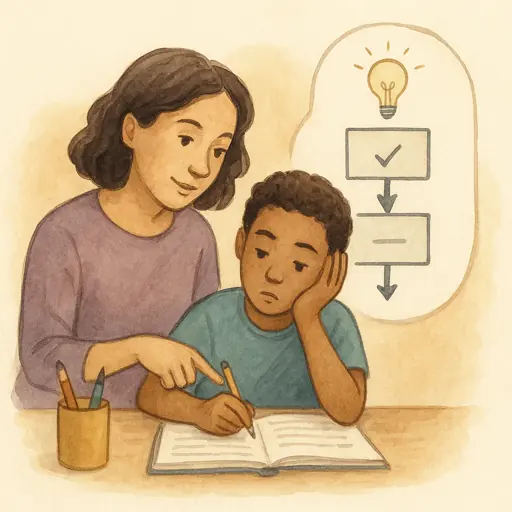
01How to Help With Homework Without Giving Away the Answer
Diagnose why a child is stuck, give the smallest useful hint, and check real understanding without completing the homework for them.
 02
02The Three-Level Hint Method Every Parent Can Use
Use a three-level hint system to clarify homework, give a productive nudge, and teach when needed while preserving independent thinking.
 03
03What to Do When the Assignment Instructions Make No Sense
Decode vague assignment instructions, find missing context, use rubrics, and help a child ask teachers precise, answerable questions.
 04
04How to Explain a Math Word Problem Without Solving It for Your Child
Help a child model math word problems with quantities, relationships, diagrams, and equations without keyword tricks or giving away the operation.
 05
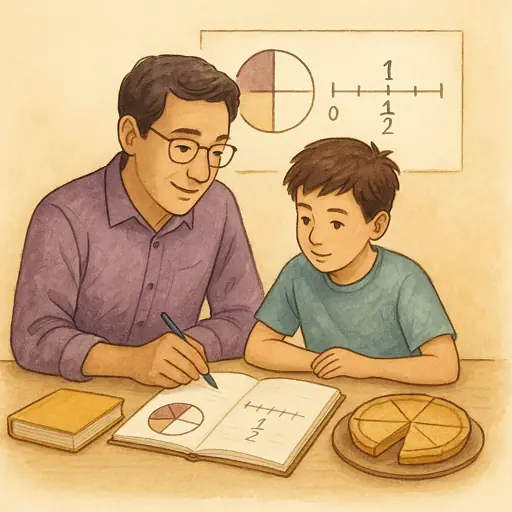
05Fractions for Parents Who Have Forgotten Fractions
Refresh fraction meaning, number lines, equivalence, comparison, and operations with practical diagnostics for common misconceptions.
 06
06How to Explain Algebra When Your Child Says ‘Letters Aren’t Math’
Explain variables, equations, equal signs, inverse operations, expressions, and functions without relying on unexplained algebra tricks.
 07
07How to Help With Reading Comprehension Without Telling Your Child What the Text Means
Diagnose decoding, vocabulary, background knowledge, structure, inference, and evidence problems without supplying the interpretation.
 08
08How to Help With Science Homework When You Do Not Know the Topic
Help with unfamiliar science homework by identifying claims, evidence, mechanisms, models, and uncertainty without pretending to be the expert.
 09
09How to Give Writing Feedback Without Rewriting Your Child’s Essay
Give feedback on ideas, structure, evidence, clarity, and mechanics while preserving the child’s ownership and authentic writing voice.
 10
10Teach Your Child to Check Their Own Work
Turn “check your work” into subject-specific routines using estimates, reverse methods, confidence ratings, error logs, and faded checklists.
 11
11Productive Struggle or Frustration? How to Know When to Help
Distinguish productive effort from destructive frustration using observable signs, a traffic-light framework, and an intervention ladder.
 12
12How to Make Homework Less of a Daily Fight
Reduce homework conflict with predictable routines, protected autonomy, and diagnosis of repeated battles instead of blame or nightly negotiation.
 13
13What to Say When Your Child Says ‘I’m Bad at Math’
Respond to math anxiety with precise diagnosis, foundation repair, credible process feedback, and language that does not turn struggle into identity.
 14
14A Parent’s Guide to Retrieval Practice and Spaced Review
Use retrieval practice, spacing, interleaving, and confidence checks to make learning last without turning home into a permanent quiz show.
 15
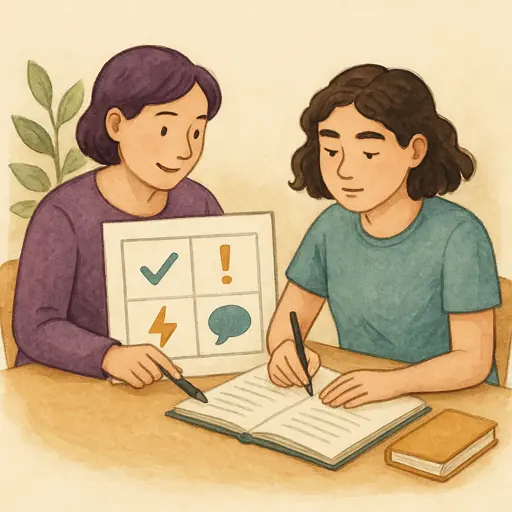
15How to Build a Study Plan Your Teen Will Actually Use
Build a teen-owned study plan with backward planning, concrete outputs, capacity limits, buffers, minimum sessions, and short weekly reviews.
 16
16How to Help Your Child Start a Big School Project
Break a large school project into deliverables, milestones, first actions, research routines, and parent checkpoints without taking over.
 17
17How to Use AI for Homework Without Letting It Do the Learning
Use AI as a tutor rather than an answer machine with learning protocols, verification, privacy boundaries, and academic-integrity rules.
 18
18When Should You Hire a Tutor? A Parent’s Decision Guide
Decide whether tutoring is needed, choose a tutor who diagnoses and teaches, set measurable goals, and avoid supervised-homework dependency.
 19
19How Parents Can Support a Child During Exam Season
Support exam season with diagnostic priorities, retrieval, spacing, sleep, error review, and calm structure without becoming the household proctor.
 20
20Test Anxiety: What Parents Can Do the Night Before and Morning Of
Use a calm plan for test anxiety the night before and morning of an exam, with logistics, sleep, reappraisal, reset routines, and escalation signs.
 21
21The Digital SAT: A Parent’s Practical Guide
Understand the current digital SAT format, adaptive modules, Bluebook setup, preparation priorities, score strategy, accommodations, and logistics.
 22
22An 8-Week SAT Support Plan for Parents
Follow an eight-week SAT plan using official diagnostics, skill repair, mixed practice, timed modules, error analysis, and a calm final taper.
 23
23ACT Prep in 2026: What Parents Need to Know
Understand the enhanced ACT in 2026: required and optional sections, timing, scoring, school-day differences, preparation, and test-day planning.
 24
24SAT vs. ACT vs. CLT: A Parent’s Decision Framework
Compare SAT, ACT, and CLT by college acceptance, format, diagnostics, logistics, accommodations, scholarships, and preparation cost—not stereotypes.
 25
25PSAT/NMSQT: What Parents Need to Know
Understand the digital PSAT/NMSQT, National Merit qualification, Selection Index, registration, preparation, and score interpretation.
 26
26AP Exam Season: How Parents Can Help Without Taking Over
Manage multiple AP exams with course-specific diagnostics, rubrics, current digital workflows, realistic triage, and protected recovery.
 27
27How to Support Your Child Before State Standardized Testing
Prepare for state testing through format familiarity, ordinary learning habits, accommodations, calm routines, and careful score interpretation.
 28
28How to Build a Balanced College List With Your Teen
Build a college list balanced across admission likelihood, affordability, academic fit, and genuine student preference—not rankings alone.
 29
29How Much Should Parents Help With the College Essay?
Set a clear boundary between useful parent feedback and ghostwriting while protecting the student’s voice and application authenticity.
 30
30How to Compare College Offers Beyond the Sticker Price
Compare college offers using net price, grants, renewal terms, loans, work-study, four-year cost, program outcomes, and financial risk.
 31
31A Family College Application Calendar From 9th Through 12th Grade
Use a grade-by-grade college planning calendar that protects student ownership and keeps academics, testing, applications, and affordability aligned.
 32
32Is Homeschooling Worth It? A Decision Framework for Families
Decide whether homeschooling fits your child by evaluating goals, learning needs, family capacity, cost, social life, legal duties, and exit options.
 33
33How Homeschooled Students Can Prepare for College Admissions
Prepare a homeschool college application with clear transcripts, school profiles, rigor, recommendations, testing, activities, and financial planning.