How Much Should Parents Help With the College Essay?
Set a clear boundary between useful parent feedback and ghostwriting while protecting the student’s voice and application authenticity.
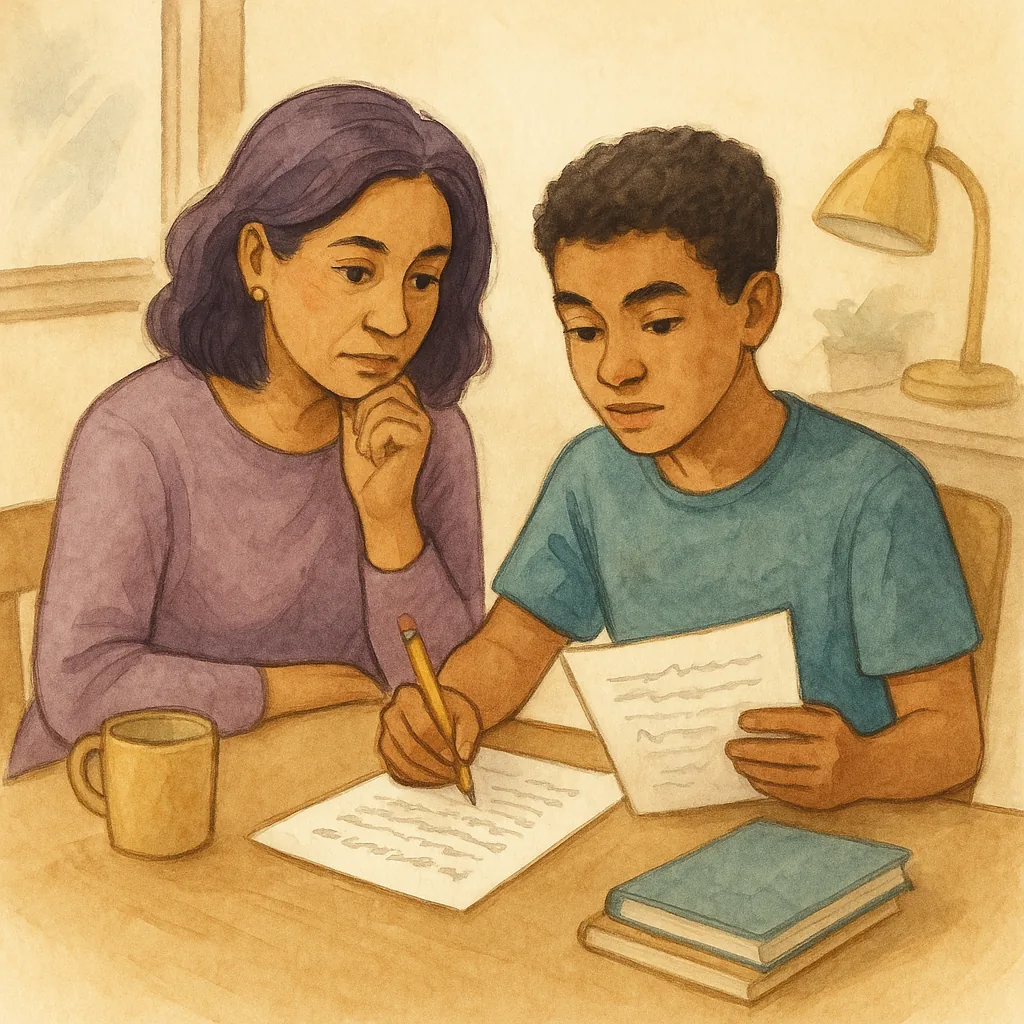
A college essay draft arrives. It contains a promising story, an unclear middle, three sentences that sound like the student, and two paragraphs that sound like a corporate annual report.
The parent wants to help. The boundary is simple in principle and slippery in practice:
The student must remain the source of the experience, interpretation, structure, decisions, and final language.
Parents may support the process. They should not become the hidden author.
Why the boundary matters
College applications require applicants to affirm the authenticity and accuracy of their work. Ghostwriting is not merely overhelping; it can misrepresent the student.
There is also a practical problem. An essay polished far beyond the student’s normal voice may:
- clash with short answers or school writing;
- contain ideas the student cannot discuss;
- erase the details that made the story personal;
- create suspicion;
- prevent the student from developing the actual skill;
- make the application least authentic at the point designed to reveal the person.
An imperfect student-owned essay is stronger than a flawless adult-owned essay wearing a teenager’s name tag.
Parents can help with process
Appropriate support includes:
- building the deadline calendar;
- helping the student understand prompts;
- asking questions that surface possible stories;
- discussing what the student wants readers to learn;
- identifying confusing passages;
- reporting where attention rises or falls;
- pointing out repetition;
- checking whether the essay answers the prompt;
- proofreading for patterns after substantive revision;
- helping the student find a counselor, teacher, or trusted reader;
- protecting time and emotional space.
The parent provides conditions and reader feedback. The student makes the writing decisions.
Parents should not
- choose the story against the student’s judgment;
- invent experiences;
- tell the student what lesson their life “should” demonstrate;
- write sentences or paragraphs for submission;
- replace ordinary language with adult professional prose;
- restructure the essay until the original logic disappears;
- use generative AI to create a personal essay;
- hire someone to ghostwrite;
- pressure the student to disclose trauma;
- submit or materially change the essay without the student’s informed approval.
Start with a story inventory, not a “perfect topic”
Ask the student to list moments involving:
- a decision;
- a contradiction;
- a small obsession;
- a failed attempt;
- a relationship that changed;
- a problem they kept returning to;
- a responsibility;
- a moment of noticing;
- an ordinary activity that reveals how they think;
- a belief revised by experience.
Avoid asking only:
“What is the most impressive thing you have done?”
The essay is not necessarily a résumé paragraph with weather effects. A modest event can reveal curiosity, judgment, humor, values, or growth more vividly than a major achievement described generically.
Ask what the story demonstrates—not what moral to attach
Useful questions:
- What did you notice that another person might have missed?
- What choice did you make?
- What did you believe before and after?
- Where were you wrong?
- What detail makes this memory specific?
- Why does this still matter to you?
- What does the story reveal that the activities list does not?
- What tension remains unresolved?
Do not force every essay into:
“I faced a challenge, worked hard, and learned perseverance.”
Admissions readers have already met perseverance. They need to meet this student.
Use a four-stage feedback process
Stage 1: purpose
After reading, answer:
- What did I learn about the student?
- What quality or pattern of mind became visible?
- What did the essay seem to be about beneath the plot?
Do not edit sentences yet.
Say:
“I learned that you are unusually attentive to how systems fail, but the final paragraph shifts into a generic message about leadership.”
Stage 2: structure
Ask:
- Where does the real story begin?
- Which scene deserves more space?
- Which paragraph repeats information?
- Does reflection grow from the event?
- Is context taking over the essay?
- Does the ending add understanding rather than summarize?
Use paragraph labels to see each section’s job.
Stage 3: specificity and voice
Mark places where:
- a concrete detail would help;
- language becomes abstract;
- the essay sounds unlike the student;
- a phrase could belong to any applicant;
- the emotional claim exceeds what the story shows.
Ask the student to explain the idea aloud, then write it themselves.
Stage 4: mechanics
Only after content and structure are stable:
- grammar;
- punctuation;
- spelling;
- word count;
- formatting;
- names and facts.
Point out patterns rather than silently repairing everything.
Use reader-response comments
Good feedback:
- “I wanted to know what you decided in this moment.”
- “This sentence made me see the scene.”
- “I understand the event, but not yet why it changed you.”
- “The phrase ‘made me a better person’ is broad. What changed in your behavior?”
- “This paragraph sounds more formal than the rest. Is that how you would say it?”
- “The ending tells me the lesson twice.”
Overstepping feedback:
- “Start with this exact sentence.”
- “You need to say that this taught you resilience.”
- “Replace your conclusion with the paragraph I wrote.”
- “This topic will impress them more.”
The first set gives the student a problem to solve. The second donates the solution.
Keep a revision ledger
After feedback, the student writes decisions:
| Feedback | Student decision | Reason |
|---|---|---|
| Opening takes too long | Cut first paragraph and begin at the repair shop | Story starts faster |
| Reflection feels generic | Add how the experience changed later project choices | Shows behavioral change |
| Tone becomes formal | Rewrite in spoken wording | Restores voice |
This makes revision intentional and prevents the student from accepting every suggestion automatically.
Know when the parent is too close
Parent-child history can make feedback difficult.
Signs:
- every comment is heard as a judgment of the life story;
- the parent wants a different identity presented;
- the student seeks approval rather than clarity;
- arguments focus on family events;
- the parent cannot tolerate an unflattering or independent perspective;
- the student stops making decisions.
Use a teacher, counselor, or trusted reader. The parent can return for logistical support and final proofreading.
AI boundaries
AI may be useful for:
- explaining a prompt;
- generating planning questions;
- checking whether a draft answers the question;
- identifying confusing passages;
- flagging repetition or grammar patterns;
- simulating a reader response.
AI should not:
- generate the personal narrative;
- invent reflection;
- rewrite the essay into a different voice;
- supply experiences;
- produce a final text the student presents as their own.
The student should follow each college’s and application platform’s current policy and be able to explain every major choice.
A safe prompt is:
“Do not rewrite. Tell me what you learn about the writer, where the narrative becomes unclear, and ask three questions that could deepen reflection.”
A practical example
Draft:
“Volunteering at the shelter taught me the importance of helping others and made me a more compassionate leader.”
Parent rewrite would be inappropriate.
Better questions:
- What happened at the shelter that challenged your previous assumption?
- What did you do differently afterward?
- Was there a moment when helping did not look heroic?
- What does “compassionate leader” mean in observable behavior?
Student revision might become:
“I stopped arriving with a list of jobs I thought needed doing and began asking the evening coordinator which task everyone avoided. For three weeks, the answer was inventory.”
That detail reveals humility and changed behavior without announcing a virtue.
Protect against trauma pressure
A student does not owe an admissions committee their most painful experience. Trauma is not a competitive category.
Ask:
- Does the student want to tell this story?
- Can they reflect on it safely?
- Does the essay reveal agency or perspective rather than only harm?
- Is the disclosure necessary?
- Are privacy and family implications understood?
- Would another topic reveal the student equally well?
If writing creates significant distress, stop and seek appropriate support.
The parent boundary test
Before making a suggestion, ask:
- Did the idea originate with the student?
- Can the student reject my suggestion safely?
- Am I describing a reader problem or supplying language?
- Does the revision still sound like the student?
- Can the student explain why every major part is present?
- Would I be comfortable describing my contribution honestly?
If the answer becomes uncomfortable, step back.
A clean division of labor
Student owns
- topic;
- facts and experiences;
- interpretation;
- outline;
- drafts;
- revision choices;
- final wording;
- submission approval.
Parent may support
- timeline;
- quiet work time;
- brainstorming questions;
- reader response;
- one or two revision priorities;
- proofreading patterns;
- emotional steadiness.
Sophia’s rule: Help the student become more visible. Do not replace them with a smoother writer.
Use Sophia as a questioning reader
Upload the prompt and draft. Ask Sophia to identify what the essay reveals, where a reader becomes confused, which details feel generic, and what questions could deepen the student’s own reflection. Reject replacement paragraphs.
The essay should not be the best prose a family can manufacture. It should be the clearest, most honest version of what the student has to say.