Test Anxiety: What Parents Can Do the Night Before and Morning Of
Use a calm plan for test anxiety the night before and morning of an exam, with logistics, sleep, reappraisal, reset routines, and escalation signs.
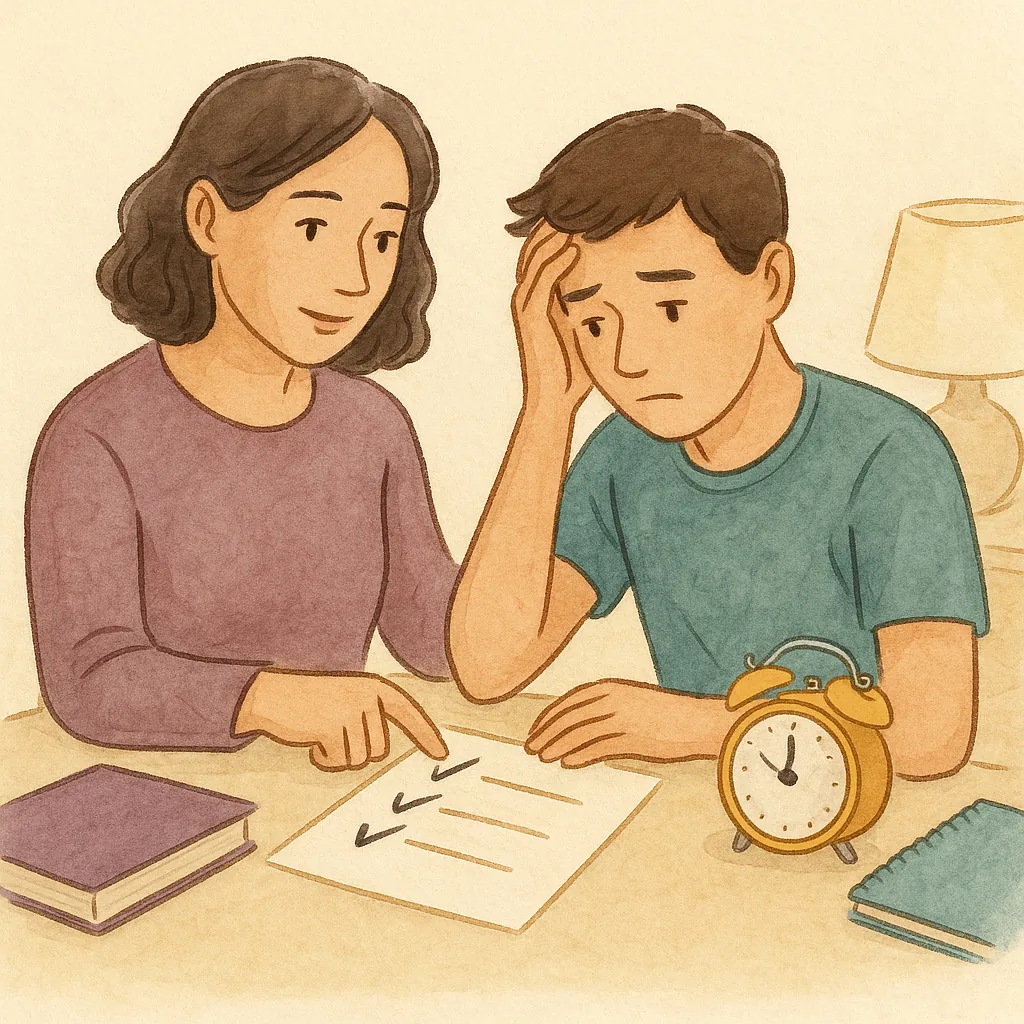
The night before an important test is a terrible time to redesign a child’s personality, repair an entire semester, or deliver a keynote address about consequences.
At that point, the parent’s job is narrower:
- reduce avoidable uncertainty;
- protect sleep and physical needs;
- help the child use a familiar coping plan;
- prevent parental anxiety from joining the exam as an unofficial extra section.
Test anxiety is not always a sign of poor preparation. It can involve physical arousal, intrusive thoughts, fear of evaluation, perfectionism, previous negative experiences, or a mismatch between knowledge and performance under pressure. It can also coexist with real knowledge gaps.
The response should match the problem.
Distinguish three situations
Ordinary activation
The child feels nervous but can still sleep, prepare, attend, and use strategies. Some activation is compatible with strong performance.
Preparation anxiety
The child is distressed because important material remains unlearned or the format is unfamiliar.
The solution includes honest triage, not only relaxation.
Impairing anxiety
The child experiences panic, vomiting, severe insomnia, blanking, refusal, or significant dysfunction. This may require school accommodations or professional support beyond test-day tips.
Do not call every nervous feeling a disorder. Do not dismiss serious impairment as normal nerves.
The night before: stop trying to learn everything
Use a final review boundary.
Good final-evening work:
- retrieve key formulas, terms, or structures;
- review the error log;
- complete a few representative items;
- rehearse a pacing plan;
- clarify one high-value uncertainty;
- stop at a planned time.
Poor final-evening work:
- a full exhausting practice test;
- opening untouched chapters;
- comparing scores with friends;
- repeatedly checking what has been forgotten;
- parent-generated surprise quizzes;
- studying until the child falls asleep on the notes.
A short, successful final set can support confidence. An endless session can teach the nervous system that the threat has no boundary.
Prepare logistics early
Uncertainty consumes attention.
Confirm:
- start time;
- location and route;
- arrival time;
- identification or admission documents;
- approved device and charger;
- calculator rules;
- pencils, pens, or other permitted materials;
- water and snack rules;
- clothing layers;
- medication or medical plan;
- accommodation details;
- backup transport;
- what happens if technology fails.
Pack the bag before the final hour. Charge devices. Complete required setup. Use official instructions for the specific exam because policies change.
Use a worry download
For some students, writing worries briefly can reduce the need to keep rehearsing them mentally.
Set a timer for five to ten minutes. Write:
- what the child fears;
- what the fear predicts;
- what is controllable;
- what the plan is if the feared moment occurs.
Example:
“I am afraid I will blank on the first math question. If that happens, I will mark it, move to the next question, complete two easier items, then return.”
Do not force positive statements the child does not believe. Convert vague catastrophe into a specific response plan.
Reframe physical arousal
A racing heart, warm face, or tense stomach can be interpreted as proof of impending failure. Help the child use a more functional interpretation:
“Your body is preparing for something important. The sensation is uncomfortable, but it does not predict your score.”
The objective is not to convince the child that anxiety feels pleasant. It is to reduce the secondary fear that nervousness itself makes success impossible.
Use a familiar calming routine
Choose one brief practice the child has already used:
- slow breathing with a longer exhale;
- progressive muscle release;
- brief stretching;
- a warm shower;
- a calm audio routine;
- a short walk;
- grounding through five visible or sensory details.
Do not introduce a complex technique for the first time and then monitor whether the child is “relaxing correctly.” The routine is a cue for downshifting, not another performance.
Protect sleep without demanding sleep
Telling an anxious child, “You must sleep or tomorrow will be ruined,” is an efficient way to make sleep more difficult.
Instead:
- keep the usual bedtime routine;
- dim stimulation;
- stop studying at a defined time;
- keep the clock out of direct view;
- remind the child that resting quietly still has value;
- avoid a late argument about screens or preparation;
- follow any established medical guidance.
One imperfect night does not automatically erase months of learning. Avoid turning wakefulness into evidence of disaster.
What parents should say at night
Useful:
- “The preparation phase ends at nine. After that, our job is recovery.”
- “Which two things would make tomorrow feel more predictable?”
- “You have a plan for a hard question.”
- “Feeling nervous does not mean you are unprepared.”
- “The result will give us information. It will not redefine you.”
Less useful:
- “There is nothing to worry about.”
- “You had better do well after all this.”
- “I know you will get the top score.”
- “Why did you not start earlier?”
- “Calm down.”
Even positive predictions can feel like pressure when the child hears them as a promise they must fulfill.
The morning of the test
Keep the routine ordinary
Use familiar food, clothing, medication routines, and travel plans. Test morning is not the ideal time to trial a revolutionary breakfast.
Allow time margin
Rushing creates avoidable arousal. Aim to arrive according to official guidance with a buffer that does not require sitting outside for half a lifetime.
Avoid last-minute content flooding
A short cue card or a few familiar reminders may help. A parent reciting every formula in the car usually does not.
Use process cues, not outcome cues
Say:
- “Read the exact question.”
- “Use your checkpoints.”
- “Move when one item is consuming the section.”
- “Reset after a hard question.”
- “Your job is the next decision, not the final score.”
Keep your own anxiety contained
Do not repeatedly ask whether the child has everything after the checklist is complete. Do not narrate traffic catastrophes. Do not scan the child’s face for evidence that the coping strategy is failing.
Calm behavior is more persuasive than calm instructions.
Give the child an in-test reset routine
A reset should take under a minute.
- Put both feet on the floor or settle posture.
- Exhale slowly.
- Name the current problem: “I am stuck on this item,” not “I am failing the exam.”
- Identify the next available action.
- Mark and move if needed.
- Re-enter with one manageable question.
For a blanking moment:
- write any related fact, formula, definition, or diagram;
- scan the question for known information;
- eliminate impossible options;
- return later if permitted.
Practice this before exam day so it is retrievable under stress.
A short coping card
The child can memorize or carry this if rules allow:
Notice: My body is activated.
Name: One hard moment is not the whole test.
Next: Read, mark, choose, or move.
Return: I can come back if the format allows.
Keep it brief. A twelve-step anxiety protocol is difficult to use while anxious.
What to do after the exam
Do not demand an immediate forensic reconstruction.
Start with:
- food;
- water;
- rest;
- transition out of test mode.
Ask later:
- What strategy helped?
- Where did anxiety interfere?
- Was pacing realistic?
- Did the format match practice?
- What should change before the next exam?
Avoid:
- “How many did you get wrong?” at the door;
- comparing answers with other students immediately;
- predicting the score from one remembered mistake;
- treating relief as evidence the child did not care.
When to seek more support
Talk with the school, pediatrician, or licensed mental-health professional when anxiety repeatedly causes:
- panic attacks;
- significant sleep loss;
- vomiting, fainting, or severe physical symptoms;
- school refusal;
- inability to complete tests despite knowing the material;
- distress across many evaluation settings;
- persistent hopelessness or self-harm statements;
- substance use to cope;
- major impairment in daily life.
Ask whether assessment conditions, accommodations, therapy, skills training, or a broader evaluation are appropriate. Emergency or self-harm concerns require immediate local help.
The final twelve-hour checklist
Night before
- Stop major studying at a planned time
- Review only high-value cues
- Pack required materials
- Charge and set up devices
- Confirm route and timing
- Use one familiar calming routine
- Write the response plan for the main worry
- Protect the normal sleep routine
Morning
- Eat and hydrate normally
- Take prescribed medication as directed
- Leave with a time buffer
- Avoid score predictions
- Use one process reminder
- Let the child enter without a final lecture
Sophia’s rule: Reduce uncertainty, protect recovery, and give anxiety a practiced response—not a debate.
Use Sophia before the final evening, not as a midnight panic machine
Use Sophia earlier to identify gaps, generate realistic practice, and rehearse a reset or pacing plan. The night before, limit it to one precise clarification or a short retrieval set. Do not invite an unlimited stream of new material when the child’s main need is closure.
The parent cannot guarantee calm or a particular score. The parent can help make the final hours predictable, respectful, and survivable—which is considerably more useful than another speech about potential.