
How to Build a Study Plan Your Teen Will Actually Use
Build a teen-owned study plan with backward planning, concrete outputs, capacity limits, buffers, minimum sessions, and short weekly reviews.
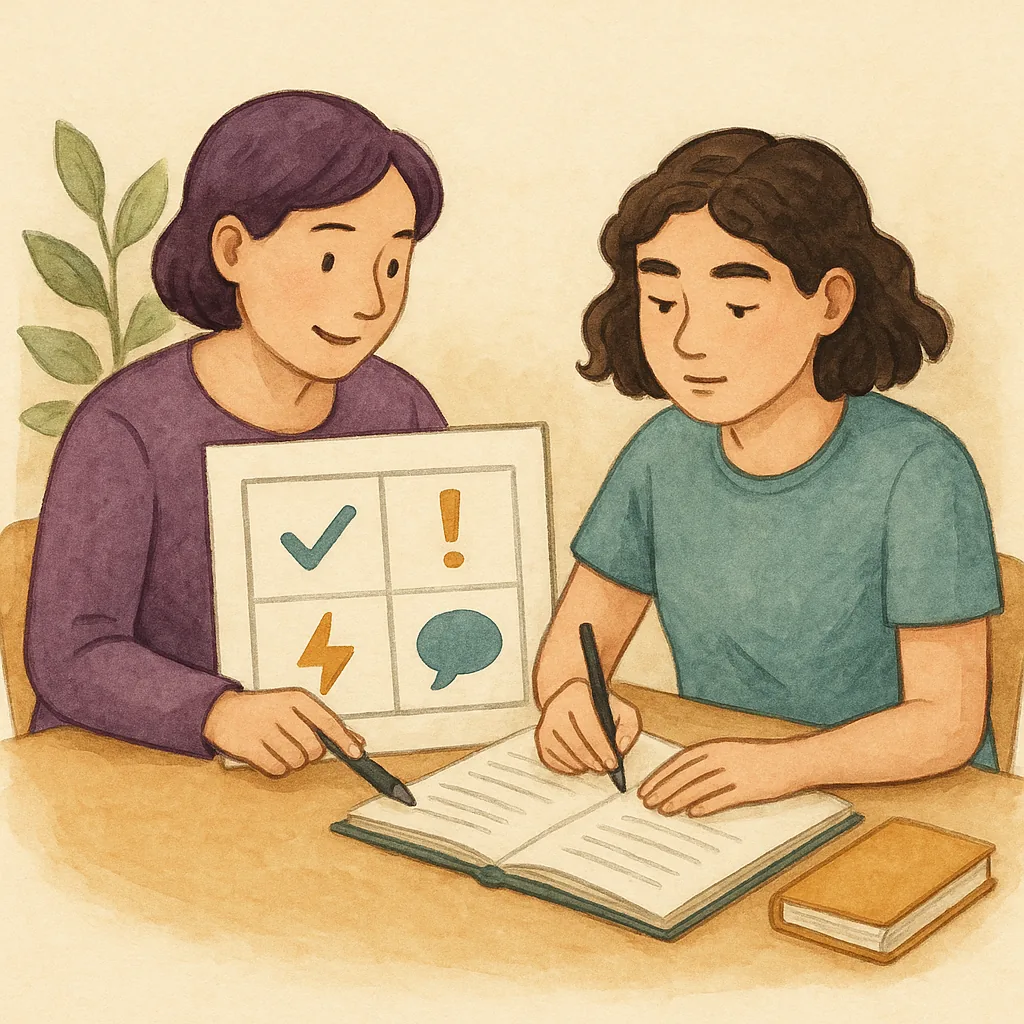
Most study plans fail for one of three reasons:
- they describe an imaginary teenager with unlimited energy;
- they contain vague tasks such as “study chemistry”;
- they were designed by a parent and assigned to the teenager as if ownership were an optional feature.
A useful plan is not the most ambitious schedule. It is a decision system your teen can still use on an ordinary Wednesday when school ran late, motivation is mediocre, and the phone contains the accumulated entertainment output of civilization.
Start with the outcome, not the calendar
Define what “ready” means.
Weak goal:
“Study for the history exam.”
Stronger goal:
“By Thursday evening, answer twenty mixed questions at 80 percent or better, explain the causes of both revolutions without notes, and review every error once.”
Concrete outcomes help the teen choose work that changes readiness rather than merely consumes time.
For a project:
“Submit a 1,200-word argument with three sources, one counterargument, citations, and a final proofread.”
For a language test:
“Recall eighty target words, use the past tense accurately in a short paragraph, and complete one timed listening section.”
Run a capacity audit
List fixed commitments before assigning study blocks:
- school hours;
- commute;
- sports, work, tutoring, or activities;
- meals;
- sleep target;
- family responsibilities;
- existing deadlines;
- recovery time;
- realistic attention limits.
Then ask:
“How many focused sessions fit without borrowing from sleep or creating a fantasy weekend?”
A plan that requires three hours every school night from a teen who has ninety available minutes is not motivating. It is inaccurate.
Let the teen define constraints
Ask:
- When is your energy usually highest?
- Which days are already overloaded?
- Where do you focus best?
- What usually prevents you from starting?
- Do you prefer one long session or several short ones?
- Which tasks require a computer?
- What support do you want from me?
- How will you know the plan is slipping?
The teen does not need total control over whether responsibilities exist. They need meaningful control over how to meet them.
Work backward from deadlines
For each assessment or project:
- write the final deadline;
- define the final readiness check;
- place a buffer before the deadline;
- identify major milestones;
- break each milestone into observable tasks;
- assign tasks to available sessions;
- keep some capacity unallocated.
Example: essay due Friday.
- Thursday: final proofread and submission check;
- Wednesday: revise argument and evidence;
- Tuesday: complete full draft;
- Monday: draft body paragraphs;
- Sunday: outline and source notes;
- Saturday: clarify question and gather sources.
The buffer matters. Without it, one disrupted evening turns the entire plan into emergency architecture.
Write outputs, not intentions
Vague task:
“Study biology for 45 minutes.”
Observable task:
“Draw the respiration process from memory, check it, and answer eight mixed questions.”
Vague task:
“Work on English.”
Observable task:
“Write the thesis and one paragraph using two quotations.”
Vague task:
“Review math.”
Observable task:
“Redo five missed problems without notes and explain the error pattern.”
Time limits are useful, but they should contain a defined action. Otherwise a teen can spend forty-five minutes rearranging materials and technically comply.
Use a weekly planning meeting
Keep it to ten or fifteen minutes.
1. Capture
List tests, assignments, projects, and personal commitments.
2. Prioritize
Consider:
- deadline;
- importance;
- current readiness;
- amount of work;
- dependency on other people;
- consequence of delay.
3. Place
Assign concrete tasks to realistic sessions.
4. Protect
Reserve sleep, meals, and some unplanned time.
5. Agree on support
Decide whether the parent will:
- provide one reminder;
- check a milestone;
- quiz on request;
- help clarify a task;
- protect quiet time;
- stay out unless asked.
Do not turn the meeting into a performance review covering every historical scheduling failure.
Use a daily launch, not a daily negotiation
The teen begins with a two-minute check:
- What is the most important task today?
- What is the first visible action?
- What materials are needed?
- What distraction will be controlled?
- When will the session end?
Example:
“At 6:30, I will put my phone outside the room, open the practice set, and complete questions 1–10 before checking answers.”
This is an implementation intention: a specific cue linked to a specific behavior.
Create a minimum viable session
Plans collapse when a teen believes a disrupted day makes the planned task impossible.
Define a reduced version:
- normal session: forty minutes and twelve questions;
- minimum session: ten minutes and three questions plus error review.
Or:
- normal session: draft two paragraphs;
- minimum session: write the paragraph claim and select evidence.
The minimum is not the default. It preserves continuity on genuinely difficult days and prevents all-or-nothing thinking.
Match task type to energy
High-energy work:
- learning a new concept;
- solving unfamiliar problems;
- writing a first draft;
- timed practice;
- analyzing difficult text.
Lower-energy work:
- organizing notes;
- reviewing flashcards;
- formatting citations;
- correcting known errors;
- watching a short assigned explanation;
- preparing materials.
Do not schedule every demanding task at the end of the teen’s longest day and then diagnose a character defect when the plan fails.
Build review into the plan
Completion is not the same as learning.
A strong study cycle includes:
- learn or clarify;
- practice;
- check;
- analyze errors;
- retrieve later;
- apply under realistic conditions.
For a math exam, a week of plans might include:
- foundation review;
- mixed untimed problems;
- targeted correction;
- timed section;
- error-based practice;
- final retrieval and rest.
Avoid using full practice tests every day. Diagnostics should inform learning, not replace it.
Track planned versus actual work
Use a simple record:
| Planned | Actual | What interfered | Adjustment |
|---|---|---|---|
| 30 min chemistry | 15 min | Practice ran late | Move remaining questions to Thu buffer |
| Essay outline | Completed | — | Draft paragraph tomorrow |
| Vocabulary review | Skipped | Forgot materials | Keep deck on phone and paper backup |
The goal is not surveillance. It is calibration.
After two weeks, ask:
- Are estimates accurate?
- Which sessions repeatedly fail?
- Which tasks are being avoided?
- Is the plan overloaded?
- Is a prerequisite missing?
- Does the environment work?
- Are reminders helping or creating resistance?
The parent’s role: sponsor, not foreman
A sponsor helps define priorities, secures resources, notices risk, and reviews milestones. A foreman monitors every minute.
Useful parent actions:
- clarify competing deadlines;
- help estimate a large project;
- protect sleep and workspace;
- ask for the teen’s plan;
- provide agreed accountability;
- help remove a specific barrier;
- communicate with school when workload or support needs are abnormal.
Less useful actions:
- rewriting the plan nightly;
- checking the grade portal repeatedly without agreement;
- interpreting every deviation as dishonesty;
- adding tasks because the teen finished early;
- demanding visible studying when the defined output is complete;
- turning planning into a moral test.
A realistic example
Teen commitments:
- math test Friday;
- literature essay Monday;
- soccer Tuesday and Thursday;
- family event Saturday;
Sunday planning
Math readiness target: complete two mixed sets, fix recurring errors, and score at least 16/20 on a timed set.
Essay target: outline by Friday, full draft Sunday, revision Monday morning buffer if needed.
Monday
- Math: eight mixed problems, log errors.
- Essay: reread prompt and choose claim.
Tuesday after soccer
- Minimum math session: redo three errors.
Wednesday
- Math: timed set and analysis.
- Essay: select evidence for three paragraphs.
Thursday after soccer
- Math: retrieve formulas and complete five weak-area problems.
- Pack calculator and materials.
Friday
- Brief review before school, no late-night Thursday cram.
- Essay outline after rest.
Saturday
- Protected family event; only ten-minute source organization if needed.
Sunday
- Draft essay in two focused sessions with a break.
The plan respects the real week rather than assuming school is the only thing in it.
When the plan keeps failing
Do not simply add stricter reminders. Diagnose.
Possible causes:
- tasks remain too vague;
- time estimates are unrealistic;
- the teen lacks the prerequisite skill;
- anxiety drives avoidance;
- perfectionism makes starting risky;
- sleep debt reduces attention;
- attention or executive-function needs are unsupported;
- the environment contains constant interruption;
- the teen did not participate in the plan;
- there are too many priorities;
- the plan measures time but not learning.
Persistent difficulty with initiation, organization, time awareness, or completion may warrant a conversation with the school or a qualified professional.
A compact plan template
Outcome
What must the teen be able to produce or do?
Evidence
How will readiness be tested?
Milestones
What must be completed before the final deadline?
Sessions
When will each concrete task happen?
Buffer
Where can delayed work move?
Minimum
What is the reduced version on a disrupted day?
Support
What will the parent do—and not do?
Review
When will the plan be adjusted based on evidence?
Sophia’s rule: A plan is credible only when it fits real capacity, names visible actions, and still works when the week is imperfect.
Use Sophia to turn goals into executable tasks
Upload the assessment date, project requirements, existing commitments, and current level of readiness. Ask Sophia to break the goal into concrete outputs and checkpoints. Let the teen choose the schedule and revise it after comparing planned work with actual results.
The best study plan is not the one that looks impressive on Sunday. It is the one the teenager can still recognize and use by Thursday.