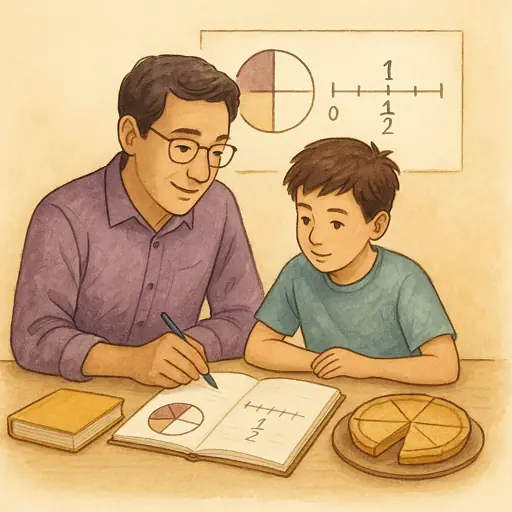
How to Explain Algebra When Your Child Says ‘Letters Aren’t Math’
Explain variables, equations, equal signs, inverse operations, expressions, and functions without relying on unexplained algebra tricks.
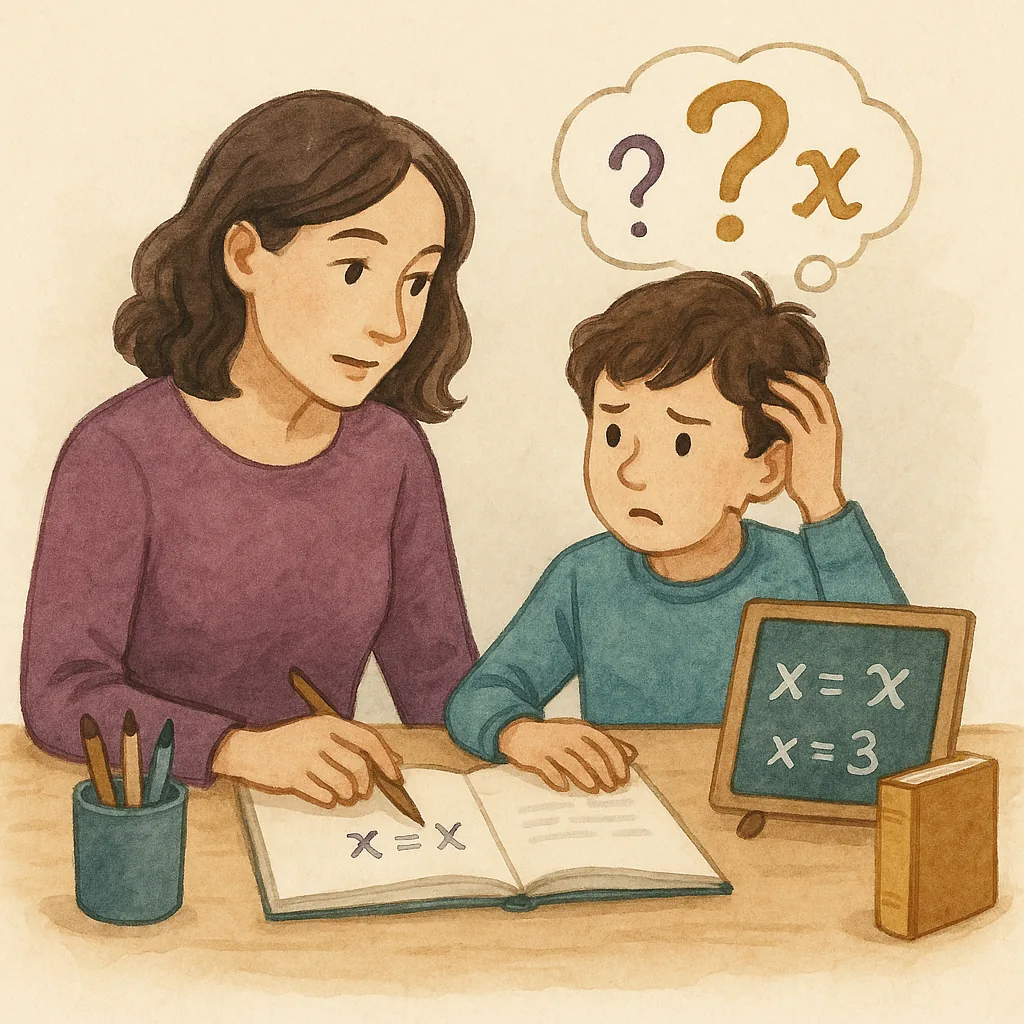
The first appearance of x can make a child feel that mathematics has been invaded by the alphabet.
The reassuring truth is that early algebra does not replace numbers with letters. It gives names to quantities so we can reason about what is unknown, what changes, and what stays true.
The dangerous way to teach algebra is as a collection of moves:
- “move it to the other side”;
- “change the sign”;
- “cross-multiply”;
- “cancel the letters”;
- “just do the opposite.”
These shortcuts can produce correct answers while hiding the logic. Then the child encounters a slightly different equation and the entire rule collection collapses like flat-pack furniture assembled without the instructions.
A better explanation begins with meaning.
A variable can play several roles
Children are often told that a variable is “a letter that stands for a number.” That is a reasonable start, but it is incomplete.
A variable can be a specific unknown
x + 5 = 12
Only one value makes this statement true. Here, x is an unknown number we are trying to identify.
A variable can represent a changing quantity
d = 60t
If a vehicle travels at 60 miles per hour, distance d changes as time t changes. Neither variable has one fixed value across every situation.
A variable can express a general relationship
a + b = b + a
This says that addition is commutative for any values where the operation is defined. The letters represent general numbers rather than one hidden answer.
You do not need to introduce all three roles in one sitting. But avoid saying that x always means “any number.” In x + 5 = 12, most numbers make the equation false.
Begin with a missing box
Write:
□ + 5 = 12
Most children can see that the box must contain 7.
Now write:
x + 5 = 12
Ask:
“What changed about the mathematical idea?”
Nothing important. The letter simply names the missing quantity. This helps a child see algebra as an extension of arithmetic rather than a new universe with hostile typography.
Then vary the position:
5 + □ = 1212 = □ + 512 = 5 + x
These versions expose whether the child understands the relationship or relies on the belief that an equal sign means “the answer comes next.”
The equal sign means “has the same value as”
One of the most important algebra foundations is a relational understanding of equality.
Many early worksheets use a pattern such as:
3 + 4 = ___
Children may interpret = as “now calculate.” Algebra requires a stronger meaning:
The expression on the left and the expression on the right have the same value.
Test this with statements such as:
7 = 73 + 4 = 5 + 28 + 1 = 910 = 6 + 45 + 3 = ___ + 2
If a child writes 8 in the last blank because they add the visible left side, return to the idea of two equal values.
Use the balance model—but know its limits
A balance scale is useful for solving equations.
Imagine:
x + 3 = 10
The two sides balance because they have equal value. Removing 3 from the left alone would break the equality. Removing 3 from both sides preserves it:
x + 3 - 3 = 10 - 3
So:
x = 7
The important rule is not “move 3 and change its sign.” The important rule is:
Perform an operation that preserves equality, and apply it to both sides.
The balance image becomes less convenient for negative numbers, expressions on both sides, or some functions, but the principle remains valid.
Explain inverse operations as undoing structure
An inverse operation reverses another operation.
- Addition and subtraction undo each other.
- Multiplication and division undo each other for nonzero divisors.
- Squaring and taking a square root can undo each other under appropriate conditions.
For:
3x + 5 = 20
Ask:
- “What happened to
x?” - “In what order?”
- “What should we undo first?”
x was multiplied by 3, then 5 was added. To isolate x, undo the outermost operation first:
3x + 5 - 5 = 20 - 5
3x = 15
Then divide both sides by 3:
x = 5
This is similar to unpacking nested boxes: reverse the order in which the layers were added.
Replace “moving terms” with legal transformations
The phrase “move the 5 to the other side and make it negative” is compact, but it hides what happened.
The 5 did not travel through the equal sign and undergo a personality change. We subtracted 5 from both sides, and the simplified result placed -5 on the other side.
For example:
x + 5 = 12
Subtract 5 from both sides:
x + 5 - 5 = 12 - 5
Then simplify:
x = 7
Once the child understands the transformation, they can use efficient notation. Meaning should precede compression.
Distinguish expressions, equations, and identities
Expression
3x + 2
An expression represents a value. It can be simplified or evaluated when x is known, but there is no equality to solve.
Equation
3x + 2 = 14
An equation states that two expressions have the same value. We can find values of x that make it true.
Identity
2(x + 3) = 2x + 6
This is true for every allowable value of x because of the distributive property.
Ask your child:
“Are we simplifying an expression, solving an equation, or showing that two forms are equivalent?”
A surprising number of algebra errors begin because the student does not know which job they are doing.
Explain coefficients and terms precisely
In 4x + 7:
4xand7are terms;4is the coefficient ofx;7is a constant;4xmeans4 × x, not4 + xand not the two-digit number “4x.”
Like terms can be combined because they count the same kind of quantity:
3x + 2x = 5x
This resembles three apples plus two apples equaling five apples.
But:
3x + 2
cannot be simplified to 5x because x-units and ordinary units are not like terms.
Use substitution as a meaning check
After solving x = 5 for:
3x + 5 = 20
substitute 5 into the original equation:
3(5) + 5 = 20
15 + 5 = 20
20 = 20
Substitution confirms that the value makes the original statement true.
It also reveals illegal simplifications. If a child claims that 2(x + 3) = 2x + 3, test x = 4:
Left side: 2(7) = 14
Right side: 8 + 3 = 11
The two forms are not equivalent.
Move from equations to relationships
Algebra is not only about hunting for x.
Consider:
y = 3x + 2
This describes a relationship. For every value of x, multiply by 3 and add 2 to obtain y.
Build a table:
| x | y |
|---|---|
| 0 | 2 |
| 1 | 5 |
| 2 | 8 |
| 3 | 11 |
Ask:
- What changes when
xincreases by 1? - What does the 2 represent when
x = 0? - How would the table change for
y = 5x + 2? - How could we show the same relationship on a graph?
The equation, table, graph, and verbal rule are different representations of the same relationship. Moving among them is central to algebraic understanding.
Common misconceptions and useful responses
“The letter is an object.”
A child may treat 3a as “three apples” in one context, then become confused when a changes meaning.
Say:
“The letter names a quantity. The context tells us what that quantity represents.”
“The equal sign tells me to calculate.”
Use nonstandard equations such as 8 = 3 + 5 and 4 + 6 = 7 + 3.
“I can cancel anything that appears twice.”
Cancellation is shorthand for dividing a factor from a product, not deleting matching symbols wherever they appear.
For example:
(3x)/(3) = x
works because numerator and denominator share a factor of 3.
But in:
(x + 3)/3
we cannot delete the two 3s because the numerator is a sum, not a product with a common factor across the whole expression.
“A negative sign belongs to the number next to it no matter what.”
Use parentheses and careful reading. Distinguish -x² from (-x)² through substitution.
“Letters make it impossible.”
Return to a table, box, diagram, or numerical example. Then reconnect the concrete example to the symbol.
A parent-friendly explanation sequence
When your child is stuck on an equation:
- Ask what the variable represents.
- Read the equal sign as “has the same value as.”
- Identify the operations applied to the variable.
- Choose a transformation that preserves equality.
- Simplify one line at a time.
- Substitute the result into the original equation.
- Ask the child to explain why each transformation was legal.
- Give a similar equation with different numbers.
What not to say
- “Just move it across.”
- “The signs magically change.”
- “Cancel the letters.”
- “You should know this.”
- “Algebra is just following rules.”
Algebra is reasoning about structure. Rules are compressed descriptions of valid reasoning, not replacements for it.
When to revisit earlier foundations
Persistent algebra difficulty may come from:
- weak understanding of the equal sign;
- insecure fraction or negative-number skills;
- difficulty with order of operations;
- confusion about multiplication notation;
- limited fluency with arithmetic facts;
- trouble translating language into relationships;
- a gap between procedural memory and conceptual understanding.
Ask the teacher which representation and vocabulary are used in class. Consistency matters. If every homework session requires reteaching prerequisites, targeted support may be more effective than repeatedly rescuing individual equations.
Sophia’s rule: Every algebra move should preserve meaning, not merely change the appearance of symbols.
Use Sophia to expose the structure
Upload the equation and begin at Level 1. Ask what the variable, expressions, and equal sign mean before requesting a next step. At Level 2, reveal one operation that would preserve equality. Use Level 3 for a full walkthrough only when the concept itself is missing, then close the solution and have the child solve a parallel equation.
Letters belong in mathematics because mathematics needs names for relationships. Once the relationship is visible, the alphabet becomes considerably less dramatic.