How to Help With Science Homework When You Do Not Know the Topic
Help with unfamiliar science homework by identifying claims, evidence, mechanisms, models, and uncertainty without pretending to be the expert.
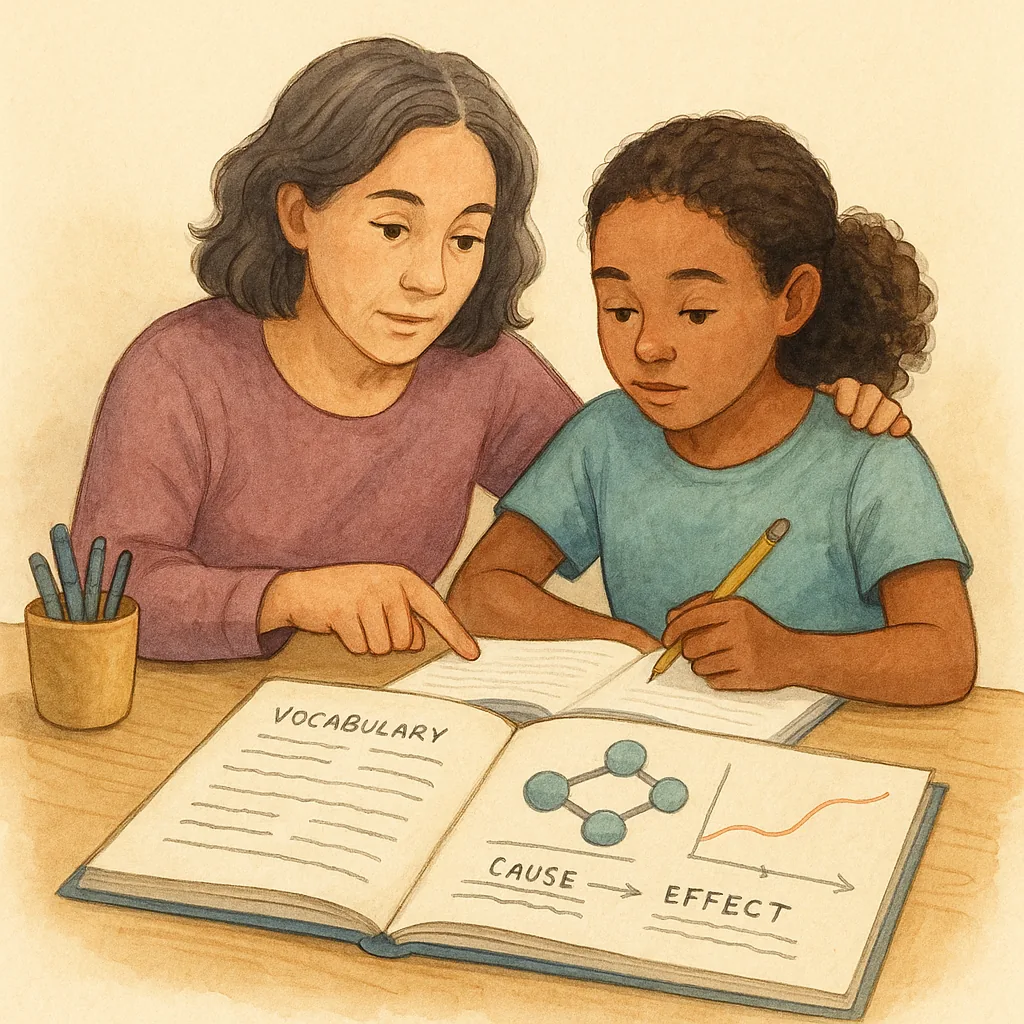
Your child asks for help explaining electromagnetic induction, cellular respiration, or why tectonic plates behave the way they do. You have two immediate thoughts:
- “I once knew this.”
- “Apparently that was in a previous lifetime.”
You do not need to know the topic better than the textbook to be useful. Science homework often tests a small set of reasoning moves that parents can support without supplying subject expertise:
- defining the question;
- distinguishing observation from explanation;
- connecting evidence to a claim;
- using a model;
- identifying variables;
- checking whether a conclusion follows;
- recognizing uncertainty.
Your role can be co-investigator, not emergency professor.
First identify what kind of science task it is
Recall
The task asks for a fact, definition, label, or sequence.
“Name the parts of a cell.”
Use notes, a diagram, or retrieval practice.
Explanation
The task asks how or why something happens.
“Explain why increasing temperature changes reaction rate.”
The child needs a mechanism, not only a result.
Data interpretation
The task presents a graph, table, or observations.
“What relationship does the graph show?”
The child must read axes, units, pattern, exceptions, and limits.
Experimental design
The task asks how to test a question.
“Design an investigation of how light affects plant growth.”
The child needs variables, controls, measurement, repetition, and safety.
Model use
The task asks the child to use or evaluate a diagram, equation, simulation, or analogy.
“Use the particle model to explain pressure.”
The child must connect model features to the phenomenon.
Argument from evidence
The task asks the child to make and defend a conclusion.
“Which material is the best insulator? Use the data.”
The child needs a claim, evidence, and reasoning.
Do not solve before identifying the task type. A definition will not satisfy an explanation question, and a graph description will not explain a mechanism.
Use the claim–evidence–reasoning framework
Many science answers can be organized into three parts.
Claim
A direct answer to the question.
“Material B is the best insulator.”
Evidence
Specific relevant observations or data.
“After ten minutes, the water in Material B’s container lost only 2°C, while the others lost 5°C and 7°C.”
Reasoning
The scientific principle connecting the evidence to the claim.
“An effective insulator slows energy transfer, so the smallest temperature decrease indicates the least heat escaped.”
Children often provide only one part:
- claim without evidence: “B is best”;
- evidence without interpretation: “It lost 2°C”;
- general knowledge without connection: “Insulators keep things warm.”
Ask:
- “What are you claiming?”
- “Which exact result supports it?”
- “Why does that result count as support?”
Ask five questions that work across science subjects
1. What is happening?
Describe the observable pattern without explaining it yet.
2. What causes or controls it?
Identify the proposed mechanism, variable, force, process, or interaction.
3. What evidence supports that explanation?
Use data, observations, or established principles from the assignment.
4. What model helps us represent it?
A particle diagram, energy-flow model, food web, circuit, force diagram, equation, or system map may reduce complexity.
5. What does the explanation not prove?
Distinguish correlation from causation, model from reality, and evidence from certainty.
A strong science answer is often not “the one true fact.” It is a conclusion whose confidence matches the evidence.
Learn to read a graph before discussing the topic
Even when the science is unfamiliar, you can help your child inspect the graph.
- Read the title.
- Name the x-axis variable and unit.
- Name the y-axis variable and unit.
- Describe the overall pattern.
- Identify unusual points or plateaus.
- Compare relevant values.
- Avoid claiming more than the graph shows.
Example:
A graph shows plant height at different light durations.
Weak response:
“More light makes plants grow.”
Better observation:
“Average height increased from four to ten hours of light, but changed little between ten and fourteen hours.”
Possible interpretation:
“Additional light was associated with greater growth up to about ten hours under these conditions, after which the effect appeared to level off.”
The careful wording matters. One graph from one experiment does not prove a universal law for every plant.
Help the child explain a mechanism
A mechanism answers:
“What process connects the cause to the result?”
Suppose the question asks why a metal spoon feels colder than a wooden spoon in the same room.
Observation:
The metal feels colder.
Incorrect shortcut:
The metal has a lower temperature.
Mechanism:
Both may be at room temperature, but metal transfers thermal energy away from the hand faster than wood, producing a stronger sensation of cold.
Ask:
- What interacts with what?
- What moves, changes, or transfers?
- In what direction?
- What intermediate step is missing between cause and effect?
- Which scientific idea explains that step?
Use models without confusing them with reality
Science relies on models because many systems are too small, large, fast, slow, or complex to observe directly.
A model deliberately simplifies.
Examples:
- atom diagrams do not show electrons as tiny planets following neat visible tracks;
- food webs simplify ecosystems;
- circuit diagrams omit physical layout;
- the “cell as a factory” analogy highlights roles but can also mislead;
- a line of best fit summarizes a trend without passing through every data point.
Ask:
- “What feature of reality does this model represent?”
- “What does it leave out?”
- “Where does the analogy stop working?”
This turns model use into reasoning rather than picture memorization.
Handle unfamiliar vocabulary efficiently
Do not define every scientific word before the child starts. Identify the few terms that control the meaning.
For each key term:
- find the class definition;
- rewrite it in ordinary language;
- give an example;
- give a non-example;
- use it in the current explanation.
For “selective permeability”:
- class definition: a membrane allows some substances to pass more easily than others;
- ordinary language: the boundary controls what gets through;
- example: small molecules may pass while others require transport proteins;
- non-example: a completely open barrier that lets everything cross equally;
- current task: explain how the membrane helps maintain cell conditions.
Do not let internet research replace the assignment
When neither parent nor child knows the topic, the temptation is to search until a polished answer appears. That answer may use a different model, vocabulary, level, or even scientific assumption than the class.
Use resources in this order:
- assignment and rubric;
- class notes;
- teacher-provided materials;
- textbook or course platform;
- reliable explanatory resource;
- AI explanation checked against the earlier sources.
The objective is not to assemble the most advanced answer. It is to understand the concept being taught and answer the actual prompt.
Treat AI-generated science claims as hypotheses to verify
AI can explain vocabulary and reorganize complex material, but it can also:
- invent references;
- state disputed ideas as settled;
- confuse similar concepts;
- use the wrong units;
- produce a plausible but impossible experimental design;
- overlook safety constraints.
Ask it to:
- separate established facts from assumptions;
- show how the explanation connects to the provided data;
- define every technical term;
- flag uncertainty;
- avoid adding facts not present in the source unless clearly labeled;
- provide a checkable reasoning chain rather than only a conclusion.
Then compare the result with class materials.
Science experiment safety is not optional
Do not improvise experiments involving:
- household chemical mixing;
- flames or high heat;
- mains electricity;
- pressure vessels;
- unknown plants, fungi, or substances;
- biological samples;
- projectiles;
- fumes;
- sharp tools;
- unsupervised online “life hacks.”
If the assigned procedure is unclear, pause and ask the teacher. A grade is not improved by accidentally inventing a small hazardous-materials incident in the kitchen.
For safe investigations, still identify:
- independent variable;
- dependent variable;
- controlled variables;
- measurement method;
- number of trials;
- recording plan;
- expected risk and cleanup.
A worked example: photosynthesis data
Question:
A student placed identical aquatic plants at four distances from a lamp and counted bubbles per minute. Plants closer to the lamp produced more bubbles. Explain the result.
Guide the child:
Task type: data interpretation plus mechanism.
Claim: Greater light intensity increased the observed rate of photosynthesis under these conditions.
Evidence: Plants closer to the lamp produced more bubbles per minute.
Reasoning: Light provides energy for photosynthesis. If the bubbles represent oxygen produced, a higher bubble rate suggests a higher photosynthetic rate.
Limitations: Bubble count is an indirect measure; temperature may also change near the lamp; the relationship may level off if another factor becomes limiting.
Notice the precision. The answer does not claim that unlimited light produces unlimited growth forever.
A worked example: forces
Question:
A book rests on a table. Explain why it does not fall.
A common child answer is:
“Because the table is there.”
Turn that into a force explanation:
- Gravity pulls the book downward.
- The table exerts an upward normal force on the book.
- The forces are balanced, so there is no acceleration.
Ask:
“What interaction creates each force, and what evidence shows the forces are balanced?”
The book remains at rest. That observation is consistent with zero net force, not with “no forces.”
When to contact the teacher
Ask for clarification when:
- the required scientific model is unclear;
- data or diagrams appear incomplete;
- the task depends on an unshared class demonstration;
- the student does not know whether outside sources are allowed;
- safety instructions are missing;
- the rubric demands evidence not provided;
- the child repeatedly memorizes terms but cannot explain relationships.
A precise question helps:
“Should the explanation use the particle model from class, or are students expected to use the gas-law equation as well?”
Sophia’s rule: In science, connect a claim to evidence through a mechanism—and match certainty to what the evidence can support.
Use Sophia as a reasoning partner
Upload the full question, diagram, data, and class context. Begin by asking what type of scientific task it is. Have Sophia separate observation, claim, evidence, and reasoning without writing the final response. Let the child assemble the explanation, then use a deeper level to check missing links or misconceptions.
You do not need to know every answer to model scientific thinking. In fact, “Let’s find out what the evidence supports” is one of the most scientific sentences a parent can say.