Fractions for Parents Who Have Forgotten Fractions
Refresh fraction meaning, number lines, equivalence, comparison, and operations with practical diagnostics for common misconceptions.
Fractions become much less mysterious when they stop being treated as two unrelated numbers stacked like a tiny apartment building.
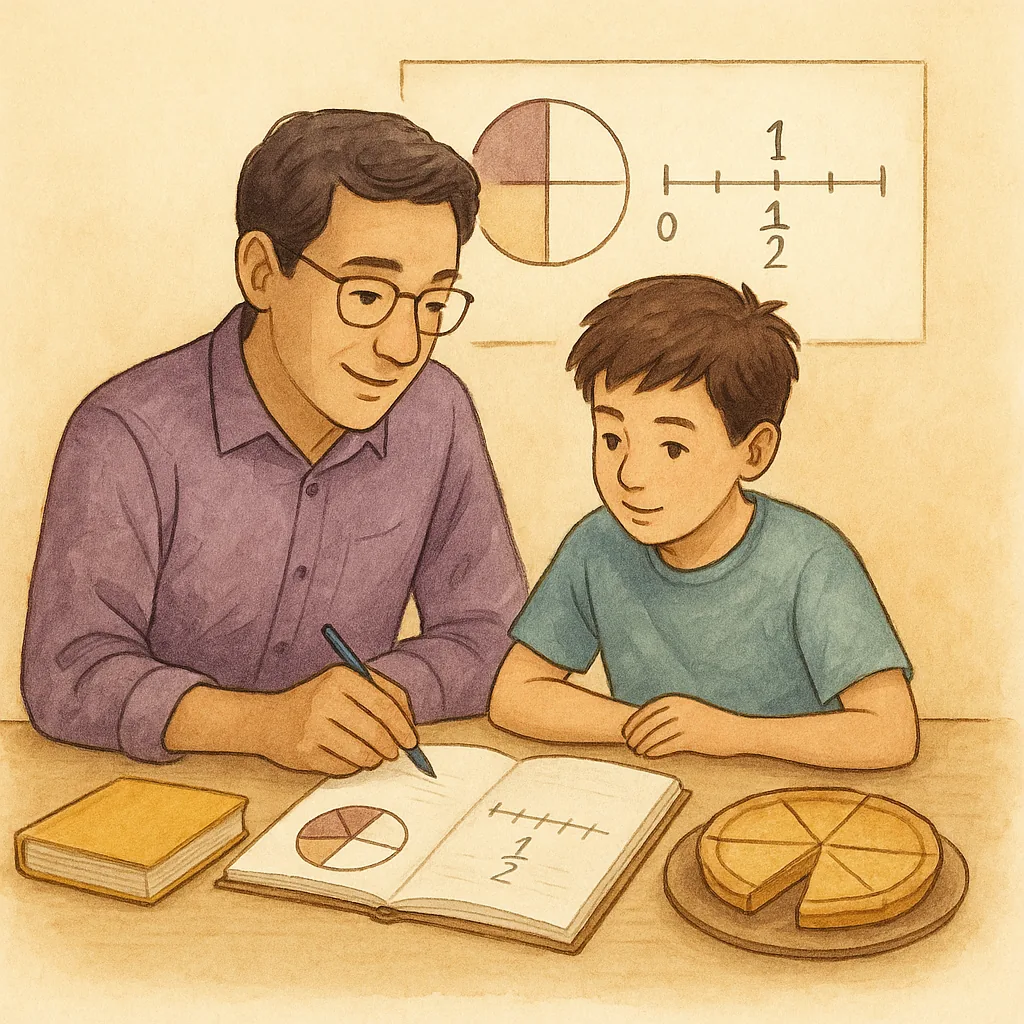
A fraction is a number. It describes a quantity in relation to a whole or a unit. The denominator tells us how the unit is divided into equal parts. The numerator tells us how many of those parts we have.
That definition sounds simple. Fractions remain difficult because children must coordinate several ideas at once:
- the whole can change;
- parts must be equal;
- a larger denominator creates smaller pieces when the whole is fixed;
- different-looking fractions can name the same quantity;
- fractions can be smaller than one, larger than one, or equal to whole numbers;
- operations on fractions do not behave like operations on two separate whole numbers.
The best way to help is to build fraction magnitude—a sense of how large a fraction actually is—before relying on procedures.
Begin with the whole
Before discussing any fraction, ask:
“A fraction of what?”
One half of a cookie, one half of an hour, and one half of a kilometer express the same relationship but not the same amount.
This matters in comparisons. A child may say that one half is always larger than three quarters because they are picturing half of a large pizza and three quarters of a small one. Fraction symbols assume the same-sized whole unless the problem says otherwise.
Try this:
- Draw two identical rectangles.
- Shade one half of the first.
- Shade three quarters of the second.
- Compare only after confirming the wholes are equal.
Equal parts are non-negotiable
Four pieces are not automatically fourths. They must be four equal shares of the same whole.
Give your child a paper strip and ask them to fold it into fourths. Then draw a rectangle divided into four unequal pieces and ask:
“Are these fourths? Why or why not?”
This reveals whether the child understands the denominator as a partition of equal-sized units, rather than simply a count of visible pieces.
Put fractions on a number line
Children often meet fractions through pizza slices and chocolate bars. Area models are useful, but they can leave the impression that fractions are only pieces of objects.
A number line makes three essential ideas visible:
- fractions are numbers with exact positions;
- their distance from zero represents magnitude;
- equivalent fractions occupy the same point.
Build a number line together
- Mark 0 and 1.
- Divide the distance into four equal intervals.
- Label
1/4,2/4,3/4, and4/4. - Ask where
1/2belongs. - Notice that
1/2and2/4share a location.
Then extend beyond one:
- Where is
5/4? - Is
6/4closer to 1 or 2? - How is
7/4related to1 3/4?
Improper fractions are not broken fractions. They are quantities greater than or equal to one.
Use benchmark fractions
Three anchors make estimation easier:
0;1/2;1.
Ask:
- Is
3/8less than or greater than one half? - Is
7/8close to zero, one half, or one? - Is
9/10more or less than one? - Is
5/4between one and two?
A child who can locate fractions roughly is less likely to accept impossible results later.
Explain equivalence as renaming the same amount
Children are often taught:
“Multiply the top and bottom by the same number.”
That procedure is correct, but without meaning it feels arbitrary.
Use a strip or number line:
- Divide one whole into two equal parts and shade one:
1/2. - Divide each half again, creating four equal parts.
- The same shaded region now contains two fourths:
2/4.
Nothing about the quantity changed. Only the name changed.
You can say:
“We made the pieces smaller, so we need more pieces to cover the same amount.”
This also explains why multiplying numerator and denominator by the same number preserves value: both the number of selected pieces and the number of total pieces are scaled together.
Compare fractions by meaning, not one universal trick
Different fraction pairs invite different strategies.
Same denominator
Compare numerators because the pieces are the same size.
5/8 > 3/8
Same numerator
Compare piece size. When the whole is fixed, fewer equal divisions create larger pieces.
3/4 > 3/7
Three fourths are larger than three sevenths because fourths are larger pieces.
Near a benchmark
Compare each fraction with one half or one.
7/8 is one eighth below one.
5/6 is one sixth below one.
Since one eighth is a smaller missing piece than one sixth, 7/8 is closer to one and therefore larger.
Common denominator
Rename both fractions using equal-sized pieces.
2/3 = 8/12
3/4 = 9/12
Therefore 3/4 > 2/3.
Cross multiplication
This can be an efficient comparison procedure, but introduce it only after the child understands that it compares equivalent products. Otherwise it becomes another spell to perform without knowing what it means.
Explain addition through units
You would not add three meters and two kilograms and call the result five something-or-others. Fraction denominators name the size of the fractional unit.
1/4 + 2/4 = 3/4
All pieces are fourths, so they can be counted directly.
But:
1/2 + 1/3
Halves and thirds are different-sized units. Rename them as sixths:
1/2 = 3/6
1/3 = 2/6
Now the sum is 5/6.
This is why adding denominators is wrong. 1/2 + 1/3 is not 2/5; the operation did not divide a whole into five equal pieces.
Explain multiplication as “of” and scaling
For whole numbers, multiplication is often introduced as repeated addition. That model becomes incomplete with fractions.
1/2 × 8 means one half of eight: four.
2/3 × 3/4 means two thirds of three quarters. An area model can show a rectangle divided in one direction into thirds and in the other into fourths. The overlap represents six twelfths, or one half.
Multiplying by a number smaller than one produces a smaller positive quantity. This can surprise children who learned that multiplication “makes numbers bigger.” Help them replace that rule with a more accurate one:
Multiplication scales a quantity. The scale factor determines whether it grows, shrinks, or stays the same.
Explain division through two questions
Division can ask either:
How many groups?
3 ÷ 1/2
How many halves fit into three? Six.
How large is each group?
3/4 ÷ 3
If three quarters are shared equally among three groups, each group receives one quarter.
“Invert and multiply” is an efficient procedure, but first show why it works in examples. A child who understands how many fractional groups fit into a quantity has something to attach the rule to.
Five quick diagnostics
Ask your child these questions without turning them into a surprise oral examination.
1. Which is larger: 1/8 or 1/6?
Correct reasoning: with the same whole, sixths are larger because the whole is divided into fewer pieces.
2. Put 3/4 on a number line
This checks whether the child sees the fraction as a number and can partition the interval equally.
3. Are 2/3 and 4/6 the same amount? Show why.
Look for a model or equivalence explanation, not only a memorized operation.
4. Is 7/5 greater or less than one?
The numerator exceeds the denominator, so the quantity is greater than one.
5. Estimate 5/6 + 7/8
Both fractions are close to one, so the sum should be close to two and definitely greater than one. An answer such as 12/14 should immediately look suspicious.
The pattern of errors tells you more than a worksheet score.
Common misconceptions and what to say
“A bigger denominator means a bigger fraction.”
Say:
“If the same pizza is divided among more people, does each person get a bigger or smaller slice?”
“Just add the top and bottom.”
Say:
“What kind of pieces would fifths be here? Did the original halves and thirds turn into fifths?”
“Improper fractions are wrong.”
Say:
“The name is unfortunate. It simply means the amount is at least one whole.”
“Multiplication always makes bigger.”
Say:
“What is one half of ten? A fraction can scale a quantity down.”
“I know the rule but forget when to use it.”
Return to meaning:
- What quantity is being combined, scaled, or shared?
- What does the denominator name?
- What should the answer be roughly?
Useful fraction activities that are not fake school at dinner
- Compare measuring-cup amounts while cooking.
- Fold paper strips into different fractional units.
- Mark fractions of an hour on a clock or timeline.
- Estimate progress through a trip, book, game, or savings goal.
- Compare discounts as fractions of an original price.
- Use a ruler to locate halves, fourths, and eighths.
- Ask which fraction of a playlist, pizza, or task is complete.
Keep the whole explicit and the parts equal. Otherwise the activity may create the very misconception you are trying to remove.
When procedures keep collapsing
If your child can follow a rule during one problem but loses it immediately, slow down. Repeated procedural forgetting may indicate that the rule has no conceptual anchor.
Ask the teacher which representation is used in class so home explanations reinforce rather than compete with instruction. Seek targeted support if the child persistently cannot compare fraction magnitudes, place fractions on a number line, or connect operations to models. These foundations affect ratios, proportions, percentages, algebra, probability, and later mathematics.
Sophia’s rule: When fractions become abstract, return to the whole, equal parts, magnitude, and the number line.
Use Sophia to reveal meaning before procedure
Photograph the exact fraction problem and start with a conceptual explanation at the child’s grade level. Ask what the whole is, what each number represents, and where the fraction would lie on a number line. Reveal the procedure only after the child can estimate what a reasonable answer should look like.
The target is not a child who can perform fraction rituals. It is a child who can tell when those rituals make sense.