How to Give Writing Feedback Without Rewriting Your Child’s Essay
Give feedback on ideas, structure, evidence, clarity, and mechanics while preserving the child’s ownership and authentic writing voice.
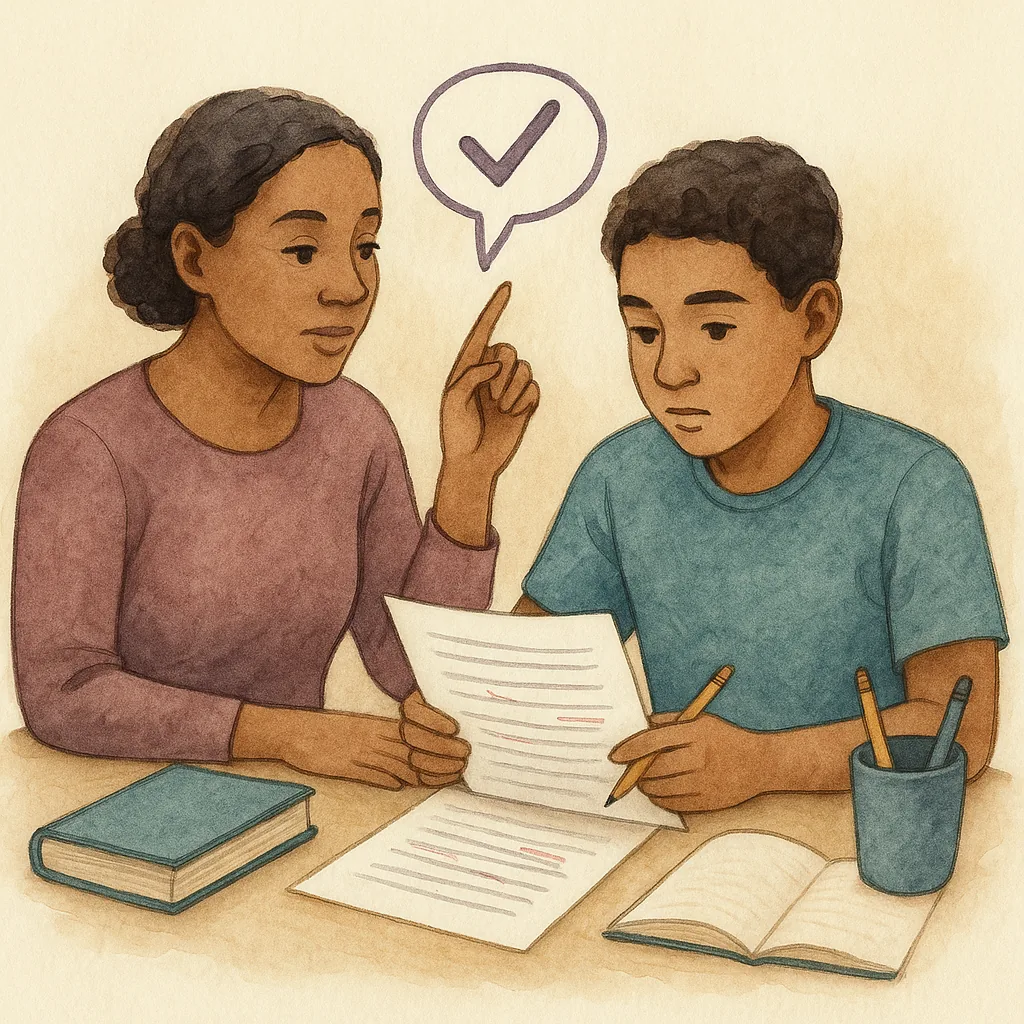
Your child hands you a draft and asks, “Is this good?”
You notice a weak opening, three repeated ideas, a paragraph that appears to have wandered in from another essay, and a conclusion held together by the phrase “in conclusion.” Your editing instincts wake up. Twenty minutes later, the document is polished—and no longer sounds remotely like the person who wrote it.
Useful feedback improves the writer, not only the current document. The child must remain the author: making decisions, revising language, and understanding why the text changed.
Ask what kind of feedback is wanted
Before reading, ask:
- “What is the assignment asking for?”
- “What stage is this draft in?”
- “What are you most unsure about?”
- “Do you want feedback on ideas, organization, clarity, or proofreading?”
- “When is it due?”
A first draft needs different help from a final proofread. Correcting commas in a paragraph that may be deleted is efficient only if your household has run out of other activities.
Use the hierarchy of revision
Review from large decisions to small ones.
1. Task and purpose
Does the draft answer the actual prompt? Is the intended audience clear? Is the required form present?
2. Main idea or claim
Can a reader state the central point? Is it specific enough to guide the essay?
3. Structure
Does each paragraph have a clear job? Is the order deliberate? Are ideas repeated or missing?
4. Evidence and reasoning
Are claims supported? Does the writer explain how examples or quotations matter?
5. Clarity and voice
Can the reader follow the sentences? Does the language sound like the child at their best rather than a committee, template, or adult ghostwriter?
6. Mechanics
Grammar, punctuation, spelling, formatting, and citation details.
Do not reverse the hierarchy. A perfectly punctuated essay can still fail to answer the question.
Read first as a reader, not an editor
On the first pass, do not change anything. Mark your genuine reader experience:
- “I understand your main point here.”
- “I expected an example after this sentence.”
- “I lost the connection between these two ideas.”
- “This detail made the scene vivid.”
- “I am not sure who ‘they’ refers to.”
- “This paragraph seems to make a second, different claim.”
Reader-response feedback is powerful because it reports an effect without dictating the solution. The writer must decide how to create a different effect.
Compare:
Rewrite:
Replace this sentence with: “The policy failed because it ignored local conditions.”
Reader response:
“I understand that you think the policy failed, but I cannot yet tell which local condition mattered most.”
The second comment preserves ownership and points to a real gap.
Limit the feedback budget
A page covered in corrections communicates one message: “Everything is wrong.” Even accurate feedback becomes unusable when the writer cannot prioritize it.
Choose one or two high-impact goals for the revision round.
For example:
- make the main claim more specific;
- explain how each quotation supports that claim.
After those changes, review organization or sentence clarity. Save final proofreading for last.
A useful feedback summary is:
- One strength to preserve
- One main revision priority
- One concrete next action
Example:
“Your examples are specific and interesting. The main issue is that the essay has two competing claims. Write one sentence stating the point you most want the reader to believe, then decide which paragraphs support it.”
Ask questions that produce revision
Weak question:
“Can you make this better?”
Stronger questions:
- “What is this paragraph trying to prove?”
- “Which sentence is the paragraph’s main point?”
- “What does this example show that the previous one does not?”
- “Where would a skeptical reader ask for evidence?”
- “What changed because of this event?”
- “Can you say this more specifically?”
- “Which sentence could be removed without losing meaning?”
- “What do you want the reader to feel or understand here?”
- “Does this sound like something you would actually say?”
Do not ask a question when you already demand one answer. “Wouldn’t it be better to start with this sentence?” is an edit wearing polite clothing.
Teach the claim–evidence–reasoning check
For analytical writing, examine each major point.
Claim
What is the paragraph asserting?
Evidence
What quotation, example, data point, or detail supports it?
Reasoning
How does the evidence support the claim?
Children often insert evidence and assume its significance is obvious.
Draft:
“The character says, ‘I will go alone.’ This shows she is brave.”
Feedback:
“What makes going alone brave in this situation? What risk does she understand, and what alternative is she rejecting?”
The revision should explain the connection, not merely repeat the label.
Help with structure using paragraph jobs
Ask the child to write a three-to-six-word label beside each paragraph:
- introduces problem;
- explains first cause;
- gives counterexample;
- describes turning point;
- compares two solutions;
- reflects on significance.
If two paragraphs have the same job, they may need combining. If the order feels random, rearrange the labels before moving whole paragraphs. If a necessary job is missing, the gap becomes visible.
This technique works for essays, reports, stories, and presentations.
Preserve the child’s voice
A child’s strongest authentic sentence may be less polished than an adult’s sentence and still be the better choice.
Voice disappears when adults:
- replace ordinary words with vocabulary the child would never use;
- smooth every surprising phrase into standard academic language;
- add ideas the child did not generate;
- rewrite humor, uncertainty, or emotion;
- impose an adult interpretation of the child’s experience;
- turn a twelve-year-old into a policy analyst from a prestigious think tank.
Ask:
“What were you trying to say here?”
Let the child say it aloud. Often their spoken explanation is clearer and more natural than the draft. Then ask them to write that idea in their own words.
Correct grammar in a way that teaches
Do not silently repair every sentence. Choose patterns.
If the child repeatedly creates comma splices:
- mark one example;
- explain the pattern;
- revise it together;
- ask the child to find the remaining examples;
- have them explain the chosen correction.
Use codes if helpful:
VT— verb tense;RO— run-on sentence;FRAG— fragment;REF— unclear reference;SP— spelling;P— punctuation.
The child must still diagnose and revise. Otherwise the parent becomes free proofreading software with snacks.
Give examples without donating sentences
Examples are useful when they demonstrate a principle on unrelated content.
If the child’s transition is weak, do not compose the exact transition for their essay. Show three transition functions using neutral examples:
- contrast: “However, the second experiment produced a different pattern.”
- cause: “Because the supply decreased, prices rose.”
- extension: “This effect also appeared in the later survey.”
Then ask which relationship exists between the child’s own paragraphs.
Use a revision plan
After feedback, the child should state the next steps.
Example:
- rewrite the thesis as one clear claim;
- remove the paragraph that does not support it;
- add reasoning after both quotations;
- reread aloud for unclear sentences;
- proofread verb tense and punctuation;
- check the rubric.
A revision plan converts comments into action and reveals whether the child understood them.
A practical example
Prompt:
“Was the explorer’s decision justified? Use evidence from the text.”
Draft opening:
“Explorers have made many decisions throughout history. Some were good and some were bad. This essay will talk about the explorer and whether his decision was justified.”
It is tempting to rewrite this completely.
Instead ask:
- “What is your actual answer?”
- “What was the strongest reason for that answer?”
- “Could the first sentence place the reader directly inside that decision?”
The child might revise:
“The explorer’s decision to continue was understandable but not justified because he ignored evidence that the route had become unsafe.”
That sentence belongs to the child because the child made the judgment and wording decisions.
Special boundaries for college and scholarship essays
A parent may:
- help plan deadlines;
- ask questions that surface stories;
- identify confusing passages;
- point out repetition;
- proofread after substantive revision;
- encourage the student to verify requirements.
A parent should not:
- write or substantially rewrite the essay;
- invent experiences or insights;
- replace the student’s voice with professional adult prose;
- submit work the student cannot explain;
- use generative tools to produce a personal essay and present it as the student’s own work.
Application essays are part of an authenticity claim. Beyond ethics, an overproduced essay may clash with the rest of the application and make the student sound least like themselves at the exact moment they are supposed to become visible.
What to do when feedback becomes conflict
If every comment feels like criticism, change the process.
- Ask permission before reading.
- Let the child choose the feedback question.
- Comment on a printed copy rather than taking control of the keyboard.
- Limit the session to one revision goal.
- Use another trusted reader when parent-child dynamics overwhelm the writing task.
- Stop before either person begins arguing about whether a semicolon represents respect.
The parent feedback protocol
- Read the prompt and rubric.
- Ask what stage the draft is in.
- Read once without editing.
- Report the reader experience.
- Select one or two high-impact priorities.
- Ask questions instead of donating prose.
- Have the child write a revision plan.
- Review the new draft for those priorities.
- Proofread patterns last.
- Ask the child to explain the final choices.
Sophia’s rule: Feedback should leave the child with more ownership and more skill—not merely a cleaner document.
Use Sophia as a reader, not a ghostwriter
Upload the prompt, rubric, and draft. Ask Sophia first to identify what is clear, where a reader loses the thread, and which requirement is not yet met. Request questions and revision priorities rather than replacement paragraphs. The child should make every substantive writing decision and be able to explain the final text.
The best edited essay is not the one a parent could have written. It is the strongest essay the child can honestly call their own.