AP Exam Season: How Parents Can Help Without Taking Over
Manage multiple AP exams with course-specific diagnostics, rubrics, current digital workflows, realistic triage, and protected recovery.
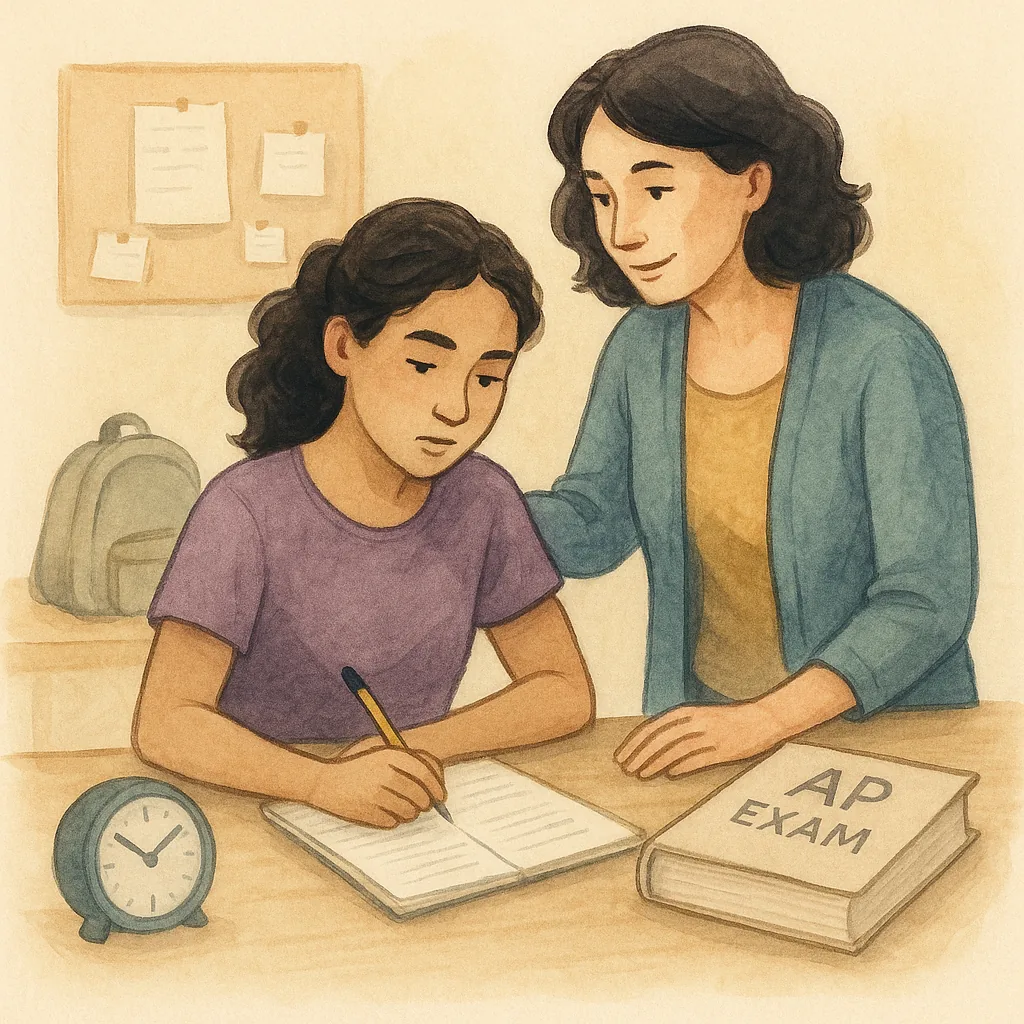
AP exam season creates a special kind of household mathematics. Three exams, two projects, one exhausted teenager, and somehow twelve review books appear on the kitchen table.
Parents can help substantially—but not by assigning more practice, rewriting study schedules nightly, or becoming an unofficial AP instructor in subjects they last encountered before the invention of Bluebook.
The useful parent role is to help the student:
- understand the exact exam format;
- prioritize across courses;
- use diagnostics and scoring rubrics;
- practice both knowledge and response production;
- prepare digital and handwritten workflows;
- protect sleep and recovery;
- escalate genuine access or workload problems.
This guide reflects AP information available in August 2026 for the 2026–27 school year and the May 2027 exam cycle. Exam mode, calculator policy, reference materials, and Bluebook requirements vary by course and can change, so families should verify each official course page and school instructions.
Start with a course-by-course exam inventory
Create one row per AP exam.
| Course | Date | Current format | Sections | Weakest area | Practice evidence | Logistics |
|---|---|---|---|---|---|---|
| AP Biology | Current mode verified | MCQ + FRQ | Experimental analysis | Bluebook/device/booklet | ||
| AP U.S. History | Format verified | MCQ, short answer, essays | DBQ sourcing | Keyboard comfort | ||
| AP Calculus AB | Format verified | Calculator/noncalculator components | Applications of integration | Approved calculator |
For the 2027 exam cycle, AP administration is digital overall, but the student experience still varies by course. An assessment may be fully digital in Bluebook, hybrid digital with handwritten free responses, portfolio-based through the AP Digital Portfolio, or delivered through a subject-specific digital workflow. “My AP is digital” is not enough detail. A hybrid exam may place multiple-choice questions and free-response prompts in Bluebook while requiring the student to handwrite the free-response answers in a booklet.
Verify:
- exam date and local start time;
- fully digital, hybrid digital, portfolio-based, or subject-specific format;
- section order and timing;
- calculator rules;
- reference materials;
- Bluebook and device requirements;
- handwritten response materials;
- accommodations;
- late-testing procedures when relevant.
Use the course framework, not a generic AP plan
Every AP course has different knowledge, skills, and response types.
Preparation should answer:
- Which units receive meaningful emphasis?
- Which task verbs appear?
- How are free responses scored?
- What evidence or work must be shown?
- Which mistakes lose points repeatedly?
- What can be practiced through retrieval?
- What requires timed production?
A student preparing for AP Chemistry needs calculation, concepts, experimental reasoning, and explanation. A student preparing for AP English Literature needs close reading, defensible interpretation, evidence, and timed writing. Both need practice, but not the same practice wearing different labels.
Begin with representative diagnostics
Use current official questions or teacher-approved materials.
For each course, sample:
- one multiple-choice set;
- one or more free-response tasks;
- one timed component;
- one broad retrieval task from the course outline.
Classify gaps:
- missing content;
- weak recall;
- misread task verb;
- incomplete reasoning;
- insufficient evidence;
- pacing;
- calculator or tool use;
- handwritten or typed production speed;
- failure to match the scoring rubric.
Do not rely only on class grades. Course grading may include homework, projects, corrections, and participation that differ from exam conditions.
Prioritize across multiple AP exams
Students often attempt equal daily time for every course. That can be mathematically neat and strategically poor.
Consider:
- exam order;
- current readiness;
- size of recoverable gaps;
- prerequisite structure;
- likely college-credit or placement value;
- other school deadlines;
- mental and physical capacity.
Use three categories:
Maintain
The student is already near target. Use brief mixed retrieval and occasional timed practice.
Improve
Several specific gaps are likely to respond to focused work.
Rescue
Major foundations are missing. Decide whether a limited set of high-value topics and response skills offers a realistic path.
“Rescue” does not mean studying twenty hours in one weekend. It means reducing the scope to what can still change.
Study for free-response questions through production
Reading model answers is useful. It does not prove the student can generate one.
A strong FRQ cycle is:
- attempt under partial or full timing;
- score using the official rubric;
- mark where points were earned or lost;
- compare with sample responses;
- rewrite only the weak component;
- complete a new prompt later;
- track the repeated scoring pattern.
For history or English:
- identify the task verb;
- make a defensible claim;
- select relevant evidence;
- explain the connection;
- address complexity or qualification where the rubric rewards it;
- manage time by paragraph or task.
For science and math:
- show required work;
- label units and quantities;
- state reasoning, not only results;
- connect data to claims;
- use correct notation;
- answer every subpart explicitly.
Use rubrics as feedback tools
Turn rubric language into checkable questions.
Instead of:
“Needs more analysis.”
Ask:
- Did the response explain why the evidence supports the claim?
- Did it address the exact historical development, scientific mechanism, or literary effect?
- Did it answer every subpart?
- Did it use the required representation or calculation?
- Did it qualify the conclusion where evidence was limited?
Rubrics reveal what the exam rewards. They should shape practice before the final week, not be discovered after the score report.
Prepare for digital and hybrid production
Students should practice:
- typing sustained responses at a comfortable speed;
- reading source material on screen;
- navigating Bluebook;
- using built-in tools;
- switching between digital prompts and handwritten work where required;
- organizing scratch work;
- entering mathematical notation under the actual rules;
- saving time for review.
For hybrid exams, rehearse the transition. A student may understand the content but lose time when moving between screen, booklet, calculator, and answer space.
Practice the permitted calculator, not an imaginary one
Calculator policies differ by AP course and sometimes by exam part. Current digital or hybrid exams may include a built-in Desmos calculator for approved courses, while handheld rules vary.
The student should know:
- which sections permit or require a calculator;
- which calculator types are allowed;
- whether memory must be cleared;
- how to use the built-in version;
- which tasks are faster by reasoning;
- what to do if a device or calculator fails.
Verify current rules. Calculator policy is not a suitable area for inherited family folklore.
Use retrieval and spacing for content-heavy courses
A course review should not be a single march from Unit 1 to Unit 9.
Use:
- blank-page recall;
- timelines;
- concept maps;
- labeled diagrams;
- formula retrieval plus explanation;
- comparison tables from memory;
- mixed questions across units;
- short cumulative reviews;
- oral teach-backs.
Return to weak content after a delay. Do not repeatedly reread the same review packet and mistake familiarity for exam access.
Build an AP error ledger
| Course | Task | Error | Cause | New rule | Recheck |
|---|---|---|---|---|---|
| Biology | Data FRQ | Described trend but no mechanism | Answered “what,” not “why” | Add process connecting variable to outcome | Thursday |
| U.S. History | DBQ | Evidence quoted but not sourced | Forgot document-analysis purpose | Explain how audience/context affects value | Saturday |
| Calculus | FRQ | Correct setup, missing units | Rushed final line | Unit check on every applied answer | Next timed set |
Review recurring patterns before practice. A ten-page log that never changes behavior is stationery, not strategy.
Protect the final two weeks from overload
As exams approach:
- reduce low-value perfectionism on ordinary assignments where school policy allows;
- ask teachers which review tasks are essential;
- stop adding new commercial resources;
- schedule difficult work at high-energy times;
- preserve movement, meals, and sleep;
- use shorter maintenance sessions for secure courses;
- place full simulations early enough for follow-up;
- taper before each exam.
Multiple APs require sequencing. After one exam, allow recovery before immediately launching a five-hour postmortem for the next.
What parents can actually do
Useful:
- maintain the master calendar;
- confirm format and logistics;
- protect focused time;
- print or organize official materials;
- quiz on request;
- help score a response using a rubric without rewriting it;
- provide transport, food, and sleep boundaries;
- support communication about accommodations or conflicts;
- ask what evidence changed the plan.
Unhelpful:
- inventing extra assignments;
- comparing siblings’ AP loads;
- treating the number of APs as a family prestige metric;
- demanding a score prediction after every practice set;
- rewriting essays or solving FRQs;
- ignoring burnout because the course is “advanced”;
- assuming a difficult exam means preparation failed.
A practical three-exam plan
Student has:
- AP Psychology first;
- AP Calculus AB three days later;
- AP English Language the following week.
Diagnostic shows:
- Psychology content mostly secure but retrieval inconsistent;
- Calculus weak on applications and FRQ notation;
- English argument essays strong, rhetorical analysis timing weak.
Plan:
Psychology
Brief daily retrieval, two mixed sets, one final practice. Maintain.
Calculus
Highest time allocation: targeted applications, timed FRQs, calculator workflow, unit and justification checks. Improve.
English
Two timed rhetorical-analysis plans, one full essay, rubric review, then maintenance until Calculus ends. Improve later.
Equal time would have overstudied Psychology and underprepared Calculus.
When to involve the school
Contact the AP coordinator, counselor, or teacher when:
- exam mode or location is unclear;
- approved accommodations are not reflected;
- device access is unresolved;
- two exams conflict;
- illness or emergency affects testing;
- the student cannot access required practice tools;
- workload across courses has become unsafe;
- a learning need requires support.
Use official procedures and timelines. Do not assume the test-day proctor can repair an issue first reported after seating begins.
After each exam
Do not conduct an immediate answer autopsy.
Ask:
- What format or pacing lesson should transfer to the next exam?
- Is any logistical adjustment needed?
- What recovery is required today?
The content of the completed exam cannot be changed. The student’s condition for the next one can.
Sophia’s rule: Manage AP season as a portfolio of different exams, not one giant undifferentiated study emergency.
Use Sophia course by course
Upload a specific prompt, rubric, graph, or missed question. Ask Sophia to clarify the task and identify the earliest missing concept or reasoning step. Use full explanations selectively, then require a new free response or problem without help.
The goal is not to make the student feel prepared through exposure. It is to produce evidence that they can retrieve, reason, and write under the format they will actually face.