How to Explain a Math Word Problem Without Solving It for Your Child
Help a child model math word problems with quantities, relationships, diagrams, and equations without keyword tricks or giving away the operation.

A child may calculate accurately and still freeze when the same mathematics is wrapped in a story about trains, paint, phone plans, or an alarming quantity of watermelons.
That is because word problems are not arithmetic with extra decoration. They require at least four different tasks:
- understand the language;
- build a mental model of the situation;
- choose a mathematical relationship;
- calculate and interpret the result.
If you immediately say “multiply” or “divide,” you may solve the decision that the problem was designed to test. A better goal is to help the child represent the situation clearly enough that the operation becomes their conclusion.
Stop teaching keyword hunting
Many children are taught shortcuts such as:
- “more” means addition;
- “left” means subtraction;
- “each” means multiplication;
- “per” means division.
These words can be clues, but they are not rules.
Consider:
Mia has 8 stickers. She has 3 more stickers than Leo. How many stickers does Leo have?
The word “more” appears, but the problem requires subtraction.
Or:
Twelve cookies are placed equally on 3 plates. How many cookies are on each plate?
“Each” appears, but the useful relationship is division.
Keyword strategies encourage children to react to individual words instead of understanding the situation. That works until the wording changes—which is precisely what good assessment questions are designed to do.
Use the six-pass method
Pass 1: describe the story without numbers
Ask your child to retell what is happening while temporarily ignoring the numbers.
- Is an amount increasing or decreasing?
- Are parts being combined into a total?
- Is a total being separated into equal groups?
- Are two quantities being compared?
- Is one quantity repeated for every unit of another?
- Is there an unknown starting value?
Example:
A tank contains 18 liters of water. Water flows in at 4 liters per minute for 6 minutes. How much water is in the tank now?
Without numbers:
“There is a starting amount, and equal amounts are added repeatedly over time. We need the final total.”
That description contains the mathematical structure before any operation is named.
Pass 2: identify the exact unknown
Have the child finish this sentence:
“I need to find ______, measured in ______.”
For the tank problem:
“I need to find the final amount of water, measured in liters.”
This prevents a common error: calculating a real quantity from the story, but not the quantity the question asks for.
Pass 3: list quantities with units and roles
Write each quantity with its unit and meaning:
- 18 liters — starting amount;
- 4 liters per minute — rate of increase;
- 6 minutes — duration;
- unknown liters — final amount.
Units often expose the relationship. Multiplying liters per minute by minutes produces liters. Adding 18 liters then produces the final amount in liters.
Teach your child to ask:
“What unit should the answer have, and how could the given units combine to make it?”
This is not a magic trick, but it is a powerful error detector.
Pass 4: choose a representation
Different problem structures become clearer through different representations.
Change problems
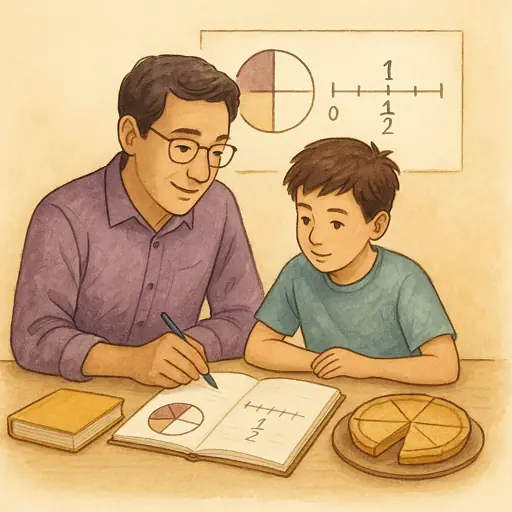
Use a number line or before-change-after diagram.
Part-whole problems
Use a bar model or partitioned diagram.
Comparison problems
Use two aligned bars so the difference is visible.
Equal-group problems
Use arrays, groups, or repeated jumps.
Rates and proportions
Use a table with paired quantities.
Multi-step problems
Use a flow diagram showing what changes at each stage.
A representation is not extra artwork. It is an external model that reduces the amount the child must hold in working memory.
Pass 5: ask the child to write a plan before calculating
The plan can be one sentence:
“First I will find how much water enters in six minutes, then add it to the starting amount.”
Only after the plan makes sense should the child select operations and calculate.
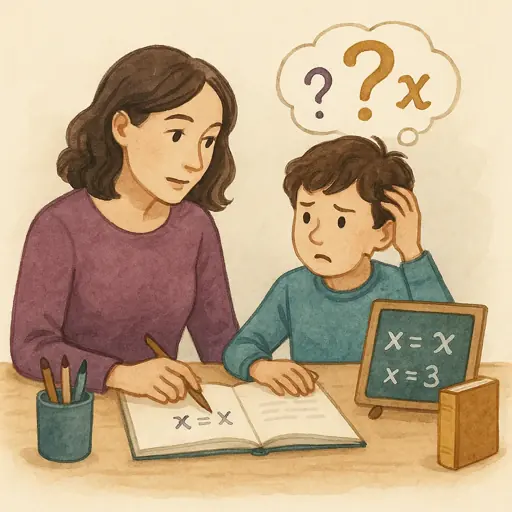
If they cannot write the plan, the difficulty is still conceptual. More arithmetic will not fix it.
Pass 6: estimate, solve, and interpret
Before exact calculation, ask for a rough range:
“Will the answer be more or less than 18 liters? Roughly how much more?”
After solving, require a complete interpretation:
“The tank contains 42 liters after six minutes.”
Then check:
- Is the unit correct?
- Is the answer plausible?
- Did every important quantity get used for a reason?
- Does the result answer the exact question?
- Can the child explain the relationship without referring only to operations?
If a movie ticket costs $480, do not blame local inflation before checking the model.
Learn the common problem structures
You do not need to teach these labels formally, but recognizing them helps you ask better questions.
Combine
Two or more parts form a whole.
Red marbles + blue marbles = total marbles.
Unknown may be the total or one part.
Change
A starting quantity increases or decreases.
Start + change = result.
The unknown may be the start, the change, or the result. This is why “left” does not always mean “subtract the visible numbers.”
Compare
Two quantities are related by a difference or ratio.
One amount is 5 greater than another.
The larger amount, smaller amount, or difference may be unknown.
Equal groups
A total, group size, or number of groups is unknown.
24 objects arranged in groups of 6.
Rate
One quantity changes in relation to another.
dollars per hour, miles per gallon, words per minute.
Proportion
Two equivalent relationships are compared.
3 cups for 2 loaves; how many cups for 5 loaves?
Naming the relationship is more transferable than memorizing which operation appeared in the last example.
Use easier numbers without changing the structure
When calculations distract from the relationship, replace the numbers temporarily.
Original:
A 17.5-ounce container costs $6.83. What is the cost per ounce?
Simplified:
If 10 ounces cost $5, how would you find the cost of one ounce?
Once the child identifies the unit-rate structure, return to the original numbers.
Be careful not to simplify the actual relationship away. Changing decimals to whole numbers is useful. Turning a two-stage comparison into a one-step addition problem is not.
Ask questions that reveal thinking
Useful prompts:
- “What is changing, and what stays fixed?”
- “What does each number describe?”
- “Which information is necessary, and which might be extra?”
- “What would the answer mean in the story?”
- “Can you draw the relationship?”
- “What simpler version has the same structure?”
- “What operation would match your plan, and why?”
- “How could you prove your answer is reasonable?”
Less useful prompts:
- “What operation do you think it is?” before the story is understood;
- “Look for a keyword”;
- “We did this yesterday”;
- “It is obvious”;
- a chain of questions that secretly supplies every step.
Diagnose whether the problem is reading or mathematics
Read the problem aloud to the child or let them listen while following the text. Then ask them to explain the situation.
- If comprehension improves substantially when someone else reads, decoding or fluency may be consuming too much attention.
- If the child understands the story but cannot represent the relationship, the issue is mathematical modeling.
- If the model is correct but calculation fails, practice the underlying arithmetic separately.
- If the child solves familiar wording but not varied wording, they may have memorized templates rather than concepts.
This distinction matters. Giving more multiplication practice will not fix a vocabulary problem. Reading the problem more slowly will not repair weak fraction understanding.
A full parent-child example
Problem:
Ava has twice as many books as Ben. Together they have 36 books. How many books does Ben have?
Parent: “Tell me the story without solving it.”
Child: “Ava has more books, and together they have 36.”
Parent: “What does ‘twice as many’ mean?”
Child: “Ava has two books for every one Ben has.”
Parent: “Could you draw equal-sized parts for that?”
The child draws one bar for Ben and two equal bars for Ava.
Parent: “How many equal parts make the total?”
Child: “Three.”
Parent: “Now write the plan.”
Child: “Divide 36 into three equal parts. Ben has one part.”
The operation now follows from the model. The parent did not hand over “36 ÷ 3,” but also did not leave the child staring at the word “twice” in despair.
When to seek more support
Talk to the teacher when the child repeatedly:
- cannot retell the situation;
- ignores units or the question being asked;
- chooses operations from keywords;
- cannot draw or explain relationships;
- succeeds only when the wording matches a memorized template;
- becomes overwhelmed by multi-step information;
- has a persistent mismatch between arithmetic skill and word-problem performance.
Bring examples showing the point at which reasoning breaks down.
Sophia’s rule: Build the situation before choosing the operation.
Use Sophia at the modeling level first
Upload the complete word problem and choose Level 1. Ask Sophia to identify the question, quantities, units, and type of relationship without naming the operation or calculating. Let your child create a diagram or plan. Reveal a Level 2 hint only if the representation still does not lead to a next step.
A word problem is solved well when the child can explain not only what they calculated, but why that calculation represents the story.