How to Help With Reading Comprehension Without Telling Your Child What the Text Means
Diagnose decoding, vocabulary, background knowledge, structure, inference, and evidence problems without supplying the interpretation.
A reading question may look simple:
“Why did the character leave?”
But answering it can require the child to decode the words, understand vocabulary, follow the sequence, connect pronouns to people, infer motivation, remember earlier details, and locate evidence. “Just read it again” does not tell you which part failed.
The most useful parent move is not to explain the passage. It is to identify which layer of comprehension is breaking down and support that layer directly.
Comprehension is a stack, not one skill
1. Decoding and fluency
Can the child read the words accurately and with enough ease to preserve meaning across a sentence?
A child who spends most of their attention sounding out words may have little mental capacity left for understanding the paragraph.
2. Vocabulary and sentence meaning
Do they understand key words, figurative language, pronoun references, and complex sentence structures?
A single word such as “reluctant,” “despite,” or “consequently” can reverse the meaning of a sentence.
3. Background knowledge
Does the text assume knowledge the child does not have?
A passage about parliamentary government, photosynthesis, or migration becomes harder when every concept is new. Reading ability cannot fully compensate for missing topic knowledge.
4. Text structure
Can the child recognize how information is organized?
Common structures include:
- sequence;
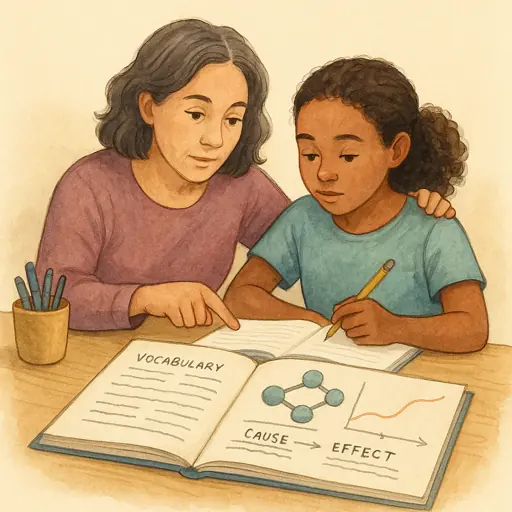
- cause and effect;
- compare and contrast;
- problem and solution;
- claim and evidence;
- description;
- chronological narrative.
5. Inference
Can the child combine textual clues with reasonable background knowledge to reach a conclusion that is not stated directly?
6. Monitoring
Does the child notice when meaning breaks down and know what to do next?
Strong readers do not understand every sentence instantly. They detect confusion and repair it.
Run a quick diagnostic before teaching
Choose a short section and try three versions.
Version A: the child reads aloud
Listen for omissions, substitutions, long pauses, and phrasing that ignores punctuation.
Version B: you read the same section aloud
Ask the child to explain it.
If comprehension improves dramatically when you read, decoding or fluency may be consuming too much effort.
Version C: paraphrase difficult vocabulary but preserve the ideas
If understanding improves after vocabulary support, the main barrier may be language rather than inference.
Then ask:
- “Who or what is this part mainly about?”
- “What changed?”
- “What caused that change?”
- “Which sentence became confusing?”
- “What do you know now that you did not know before?”
Do not turn the diagnostic into a cross-examination. You need enough evidence to choose the next support.
Use the chunk–retell–connect routine
Chunk
Read a manageable section: one paragraph, one scene, or a few sentences. The right size depends on the child and text.
Retell
Ask for an informal retelling without looking at the question.
“Tell me what this part says in your own words.”
Do not demand a polished summary. Listen for the central idea, sequence, relationships, and missing information.
Connect
Ask how the chunk relates to what came before.
- “What changed from the previous paragraph?”
- “Does this support or challenge the earlier idea?”
- “What question did this section answer?”
- “What new question does it create?”
This prevents the child from understanding sentences individually while losing the larger thread.
Separate what the text says from what the reader concludes
Teach two columns:
| In the text | My reasoning |
|---|---|
| The character hides the letter and changes the subject. | She may be afraid someone will discover the truth. |
An inference is not a guess floating freely above the page. It is a conclusion constrained by evidence.
Use this sentence frame:
“I think ______ because the text says ______, which suggests ______.”
For younger children:
“The clue is ______, so I think ______.”
If the child gives an interpretation, do not immediately approve or reject it. Ask:
“Which detail makes that interpretation stronger than another one?”
Teach question words as instructions
Small words in reading questions change the task.
According to the text
Use directly stated information.
Mainly or central idea
Choose the idea that organizes the passage, not merely an interesting detail.
Most likely
Infer the best-supported conclusion, not something merely possible.
Best supports
Find evidence that directly strengthens the claim in the question.
Purpose
Explain what a sentence, example, paragraph, or feature does in the text.
Tone
Infer the author’s or speaker’s attitude from word choice and context.
Have the child underline the question’s task word before returning to the passage.
Handle fiction and nonfiction differently
For fiction, track change
Ask:
- What does the character want?
- What obstacle appears?
- What choice do they make?
- What do they know at this point?
- How do relationships change?
- Which details reveal emotion or motive without naming it?
Avoid reducing every story to a moral. Literature often explores tension rather than delivering a laminated life lesson.
For nonfiction, track the author’s work
Ask:
- What question is this section answering?
- What claim is being made?
- What evidence supports it?
- Is the author defining, comparing, explaining causes, or proposing a solution?
- What role does this example play?
- Which terms must be understood precisely?
A simple margin label—“claim,” “example,” “cause,” “contrast,” “definition”—can reveal structure without covering the page in fluorescent ink.
Build background knowledge without replacing the reading
Before a difficult text, spend a few minutes activating or supplying essential context.
For a passage about coral bleaching, clarify:
- what coral is;
- that many corals live in partnership with algae;
- why temperature changes matter.
Then return to the assigned text. Background knowledge should open the door, not become an unrelated documentary marathon.
Ask the child what they already know and what the title, headings, images, or captions suggest. This creates a framework for new information.
Teach repair strategies
When meaning breaks down, a child can:
- reread a smaller section;
- slow down at the sentence that caused trouble;
- replace a pronoun with the noun it refers to;
- define or infer a key word;
- split a long sentence into clauses;
- summarize the paragraph in one line;
- inspect headings, diagrams, captions, or footnotes;
- read ahead briefly for clarification;
- ask a precise question;
- compare the section with a simpler explanation, then return.
“Reread” is useful only when paired with a different approach. Repeating the same unsuccessful reading at the same speed is not a strategy; it is an encore.
A practical example
Passage:
“Although the town initially welcomed the new factory, enthusiasm faded when residents noticed that fish were disappearing from the river. Company officials denied a connection, but a later inspection found untreated waste entering the water upstream.”
Question:
“Why did the residents’ attitude toward the factory change?”
Instead of answering, guide the child:
- “What did residents think at first?”
- “Which word signals a change?”
- “What did they notice?”
- “What did the inspection later find?”
- “Now connect the evidence in one cause-and-effect sentence.”
Possible response:
“Residents became less supportive because fish disappeared, and an inspection later connected pollution upstream with untreated factory waste.”
The parent made the structure visible. The child still constructed the answer.
Do not over-question
Parents sometimes respond to every sentence with a question. This can make reading feel like being followed through a museum by an auditor.
Use questions strategically:
- before reading, to set a purpose;
- at meaningful stopping points;
- when comprehension actually breaks;
- after reading, to organize and support an answer.
Sometimes direct teaching is more efficient. If the child does not know what “consequently” means, explain it. Do not ask twelve clues and hope the conjunction reveals itself through character development.
What to praise
Praise behaviors that build independent comprehension:
- noticing that a sentence did not make sense;
- returning to evidence;
- revising an interpretation;
- identifying a key word;
- connecting sections;
- distinguishing a fact from an inference;
- asking a precise question.
Avoid praising only correct answers or fast reading.
When to talk with the teacher or a specialist
Seek more information when the child repeatedly:
- reads words inaccurately or extremely slowly for their age;
- understands text when heard but not when read independently;
- cannot retell even short passages;
- has persistent vocabulary or language difficulties;
- loses meaning across complex sentences;
- guesses answers without evidence;
- avoids reading or experiences intense distress;
- shows a widening gap between oral understanding and reading performance.
A reading difficulty is not proof of low intelligence or low effort. Precise assessment can distinguish decoding, fluency, language, attention, and comprehension needs.
Sophia’s rule: Do not supply the meaning. Identify the layer that is blocking meaning and support that layer.
Use Sophia as a comprehension guide
Upload the passage and question together. Begin by asking Sophia to explain what kind of reading work the question requires—fact, main idea, inference, purpose, tone, or evidence—without selecting the answer. Then let your child locate clues and explain the connection in their own words.
The best sign of comprehension is not that the child can repeat your interpretation. It is that they can build and defend one of their own.