Is Homeschooling Worth It? A Decision Framework for Families
Decide whether homeschooling fits your child by evaluating goals, learning needs, family capacity, cost, social life, legal duties, and exit options.
“Is homeschooling worth it?” sounds like a question about educational philosophy. For most families, it is actually a question about fit, capacity, trade-offs, and what problem they are trying to solve.
Homeschooling can offer flexibility, customization, safety, time for health needs, freedom to move faster or slower, and space for a child whose current school environment is not working.
It can also create a heavy teaching and administrative job, reduce access to services, strain a parent-child relationship, narrow a child’s social world, and cost far more time and money than a curriculum subscription suggests.
There is no responsible universal verdict. The useful question is:
For this child, in this family, under these legal and practical conditions, is homeschooling the best available option right now?
Do not begin with the curriculum
Families often start by comparing programs. That is backwards.
Before choosing materials, define the problem.
Complete these sentences separately as adults, then ask the child for their view:
- We are considering homeschooling because…
- The current arrangement is failing when…
- We hope homeschooling would improve…
- We would know it is working if…
- We would reconsider if…
Possible goals include:
- escape from bullying or an unsafe environment;
- better support for disability, illness, or mental health;
- more appropriate academic pace;
- greater schedule flexibility;
- stronger family or cultural alignment;
- time for athletics, arts, travel, or work;
- recovery after school refusal or burnout;
- access to education while moving frequently;
- a temporary bridge during a difficult period.
A vague goal such as “better education” is too slippery to evaluate. Translate it into observable outcomes.
For example:
- “fewer morning panic episodes”;
- “consistent progress in reading fluency”;
- “advanced mathematics without waiting for the grade-level sequence”;
- “two stable peer activities each week”;
- “schoolwork completed in four focused hours rather than nine distressed hours”;
- “the child can explain what they learned and work increasingly independently.”
Compare homeschooling with the real alternatives
The choice is rarely only “current school or full-time parent-led homeschool.”
Possible alternatives include:
- a different public school;
- a charter or magnet school;
- a private school;
- a public virtual program;
- an accredited online school;
- a hybrid school;
- a microschool;
- a cooperative;
- part-time enrollment where permitted;
- disability accommodations or a revised education plan;
- subject acceleration;
- tutoring;
- temporary medical instruction;
- a change of class, teacher, or schedule;
- full homeschooling with outside courses.
For each option, compare the same criteria. Otherwise, homeschooling receives an idealized description while the current school is judged by its worst Tuesday.
Understand what “homeschooling” will mean in your home
Homeschool models differ dramatically.
Parent-led model
The parent selects curriculum, teaches, assesses, keeps records, and coordinates activities.
Structured online model
A provider supplies lessons, pacing, assessment, and sometimes teachers. The parent still manages attendance, motivation, technology, and daily follow-through.
Outsourced subject model
The family combines parent teaching with tutors, online courses, dual enrollment, community classes, or specialist instruction.
Project-based or interest-led model
Learning is organized around projects, questions, real-world work, or the child’s interests. Families still need a way to ensure broad skill development and document progress.
Hybrid model
The child attends a program for part of the week and learns at home for the rest.
The label does not tell you who will do the work. Write down, subject by subject, who teaches, who checks progress, and what happens when the child is stuck.
Evaluate family capacity honestly
Homeschooling does not require a parent to know everything. It does require a functioning system for finding instruction, monitoring learning, and responding when the plan fails.
Time
Estimate the whole job:
- instruction;
- lesson preparation;
- finding resources;
- reviewing work;
- recordkeeping;
- transportation;
- activity coordination;
- emotional regulation;
- communication with providers;
- legal reporting;
- planning the next week or term.
A child may need fewer formal instructional hours than in a school day, but the parent’s workload is not equal to the child’s worksheet time.
Income and employment
Ask:
- Will an adult reduce paid work?
- What income, benefits, or career progression may be lost?
- Can work and teaching occur without both being performed badly?
- Is another adult reliably available?
- What happens during a work emergency?
The cost of homeschooling includes opportunity cost, not only books.
Teaching role
You do not need to imitate a classroom teacher. You do need to tolerate:
- repetition;
- incomplete understanding;
- resistance;
- changing plans;
- admitting you do not know;
- bringing in outside help;
- separating academic feedback from personal conflict.
A brilliant curriculum cannot compensate for a daily relationship in which every correction becomes a power struggle.
Executive function
Who will create external structure?
Some children thrive with flexibility. Others experience “flexibility” as an endless unstarted day.
Consider whether the child can:
- begin tasks;
- shift between activities;
- sustain attention;
- work without constant adult proximity;
- estimate time;
- tolerate difficult work;
- recover from mistakes.
If not, homeschooling may still work, but the plan needs visible schedules, short work blocks, clear completion criteria, and gradual independence.
Backup capacity
What happens if the primary teaching parent becomes ill, overwhelmed, employed differently, or responsible for another family crisis?
A sustainable plan has substitutes:
- another adult;
- online instruction;
- tutor support;
- cooperative classes;
- a lighter emergency schedule;
- a known route back to school.
If one exhausted person is the curriculum, teacher, principal, counselor, transportation department, and entire social infrastructure, the system has a single catastrophic point of failure.
Evaluate the child, not the fantasy student
Homeschooling is not automatically child-centered merely because it happens at home.
Ask how this specific child responds to:
- adult direction from a parent;
- reduced peer contact;
- self-paced work;
- quiet environments;
- online learning;
- frequent transitions;
- unstructured time;
- sibling proximity;
- correction;
- independent reading;
- long-term projects.
Include the child’s voice
A young child does not make the entire decision. An older student’s informed opposition should carry serious weight.
Ask:
- What is hardest about school now?
- What would you miss?
- What do you hope would change?
- How would you stay connected to friends?
- What would a good learning day look like?
- What responsibilities are you willing to take?
- What would make you want to return?
Do not sell homeschooling as permanent freedom from uncomfortable work, schedules, evaluation, or other people. Those needs do not vanish; they change form.
Investigate legal duties before withdrawing
In the United States, homeschool requirements are set largely at the state level and can differ substantially. Families may need to address items such as:
- notice or registration;
- compulsory-attendance rules;
- parent qualifications;
- required subjects;
- instructional days or hours;
- assessments;
- portfolios;
- immunization or health records;
- recordkeeping;
- high-school credits;
- withdrawal procedures.
Do not rely on a social-media summary written for another state or another year. Check current government guidance and, where needed, qualified local advice before changing enrollment.
Families outside the United States should treat the legal question as entirely jurisdiction-specific. Homeschooling may be regulated, restricted, or unavailable.
Check disability and service implications
A child’s access to evaluations, therapies, accommodations, special education, transportation, and related services may change after leaving public school. The details depend on federal rules, state treatment of homeschool students, district procedures, and the child’s placement.
Before withdrawing, ask in writing:
- Which current services would continue?
- Which would end or change?
- Can the child still be evaluated?
- What documentation is needed?
- Who delivers services, where, and how often?
- What happens if the child reenrolls?
- Are therapies available privately, and at what cost?
Do not assume that an existing school plan transfers unchanged into homeschooling.
Build an academic plan that can reveal failure
A plan is not “we bought Grade 6.”
For each major subject, define:
- starting level;
- annual priorities;
- core materials;
- teaching provider;
- weekly rhythm;
- practice method;
- how understanding will be checked;
- what counts as adequate progress;
- what triggers intervention.
Use multiple forms of evidence:
- independent work;
- oral explanation;
- projects;
- quizzes;
- writing samples;
- reading conferences;
- cumulative review;
- external assessments where useful;
- feedback from instructors other than the parent.
A child completing screens or pages is not proof that learning occurred.
Watch for hidden gaps
Flexible education can become narrow education. Protect time for:
- reading and writing;
- mathematics;
- science;
- social studies and civics;
- arts;
- physical activity;
- digital literacy;
- research;
- discussion;
- practical life skills.
Older students also need deliberate course sequencing. A missing prerequisite can close future options long before anyone notices.
Design social life as infrastructure
The useful question is not “Will my child be socialized?” It is:
Where will this child have repeated, meaningful contact with peers and adults outside the immediate family?
Healthy social development needs more than occasional field trips. Look for:
- stable friendships;
- recurring groups;
- teamwork;
- conflict and repair;
- contact with different ages and backgrounds;
- trusted adults outside the family;
- opportunities to contribute;
- unstructured peer time;
- belonging, not merely attendance.
Possible settings include:
- sports;
- arts;
- clubs;
- libraries;
- faith communities;
- cooperative classes;
- volunteering;
- part-time work;
- community college;
- neighborhood friendships;
- youth organizations.
Count logistics. A beautiful social plan that requires twelve weekly drives may destroy the family schedule by October.
Calculate the real budget
Include:
- curriculum;
- books;
- devices and internet;
- printing and supplies;
- lab materials;
- tutoring;
- online courses;
- assessments;
- cooperative fees;
- sports and arts;
- transportation;
- childcare for siblings;
- lost income;
- therapy or services no longer provided;
- college-level courses for older students;
- exam and application fees.
Build a low, expected, and high scenario. “We will find free resources” is not a plan for specialized instruction.
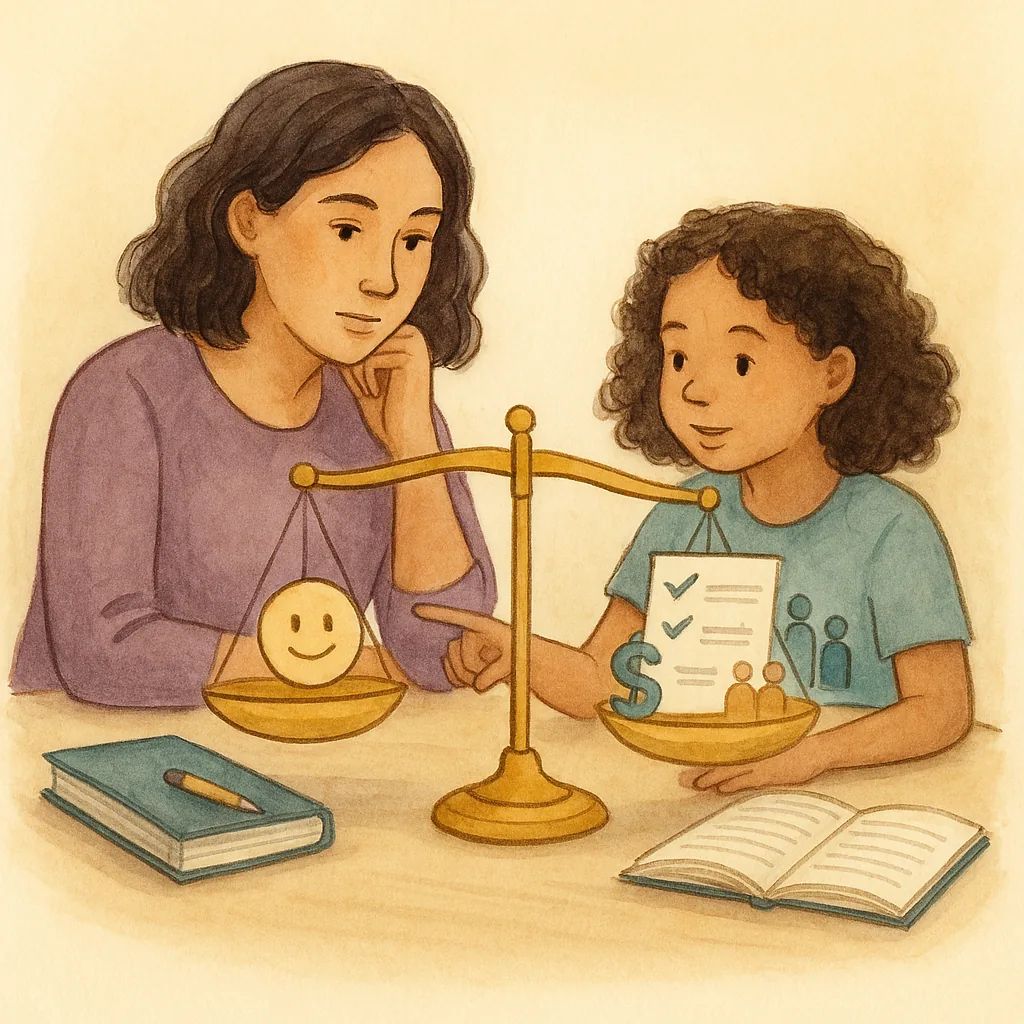
Use a decision scorecard
Score each realistic option from 1 to 5, then add written evidence.
| Criterion | Current school | Homeschool | Alternative option |
|---|---|---|---|
| Physical and emotional safety | |||
| Academic fit | |||
| Disability or health support | |||
| Child preference | |||
| Family time capacity | |||
| Financial sustainability | |||
| Parent-child relationship | |||
| Peer and community access | |||
| Future course access | |||
| Administrative feasibility | |||
| Backup and exit options |
Do not blindly total the numbers. A scorecard exposes disagreements and hidden assumptions. Safety or essential services may outweigh a higher total elsewhere.
Run a realistic simulation before committing
Without violating attendance rules or pretending the child has already withdrawn, test the proposed system during a school break, weekend sequence, or temporary period when lawful.
For one or two weeks, simulate:
- wake time;
- independent start;
- two or three instructional blocks;
- breaks;
- parent work obligations;
- device limits;
- outside activity;
- end-of-day cleanup;
- planning for tomorrow.
Use actual material at the expected level. Do not run a “trial” made entirely of documentaries, baking, and a cheerful museum visit. Those can be educational, but they do not test how the family handles spelling correction on a rainy Wednesday.
Observe:
- how often prompting is needed;
- whether the child can work independently;
- what creates conflict;
- how long planning takes;
- whether work obligations remain realistic;
- how siblings are affected;
- what the parent feels after several days.
Establish success measures and review dates
Decide before starting what you will review after six weeks, one semester, and one year.
Possible measures:
- academic progress from the starting point;
- attendance and consistency;
- anxiety or school-refusal symptoms;
- sleep;
- independence;
- family conflict;
- peer contact;
- outside-teacher feedback;
- cost;
- parent workload;
- child willingness to continue.
Write down the evidence that would trigger a change.
Examples:
- no measurable reading progress despite consistent instruction;
- daily conflict that damages the relationship;
- parent workload is incompatible with employment;
- serious isolation;
- worsening mental health;
- inability to provide required advanced subjects;
- loss of essential services;
- the child persistently asks to return.
Changing course is not failure. Refusing to notice that a plan is failing is failure with better branding.
Build the exit plan before the entrance
Know:
- how reenrollment works;
- which records the school may request;
- how credits will be evaluated;
- whether midyear return is possible;
- what placement testing may occur;
- how special services would restart;
- which local alternatives exist.
Keep records good enough that the child is not trapped by the family’s decision.
When homeschooling is more likely to fit
It may be promising when:
- the problem is clearly defined;
- the child benefits from a different pace or environment;
- an adult has sustainable time and willingness;
- outside expertise is available where needed;
- social connections are concrete;
- legal duties are understood;
- the family can monitor real progress;
- the child has meaningful input;
- the plan has backup and review points.
When it deserves extra caution
Be careful when:
- the decision is mainly a reaction to one conflict;
- the family expects the child to teach themselves online all day;
- a parent must secretly work full-time while supervising full-time;
- the child strongly opposes the plan;
- homeschooling is being used to avoid an unaddressed disability or mental-health need;
- social opportunities are theoretical;
- the parent-child relationship is already dominated by academic conflict;
- finances depend on ignoring lost income;
- there is no way to teach advanced or difficult subjects;
- no one has checked current law;
- the family treats returning to school as shameful.
Three brief family cases
Case 1: A strong fit with outside support
A medically vulnerable seventh-grader has frequent absences and becomes exhausted by the school schedule. One parent has flexible work, the family confirms service implications, and the child keeps two recurring peer activities. Core subjects use a mixture of parent teaching and live online classes. Progress and health are reviewed every six weeks.
The strength is not homeschooling alone. It is the alignment between the child’s need and a resourced plan.
Case 2: A solvable school problem, not a reason to rebuild education
A ninth-grader wants to leave after conflict with one teacher and a friend group. The family first tries a schedule change, counseling, a different class, and a defined review period. The situation improves.
Homeschooling would have solved the immediate discomfort while creating larger academic and social costs.
Case 3: A plan that looks flexible but is not sustainable
Two parents work full-time. They buy a self-paced online curriculum and expect an eleven-year-old with attention difficulties to complete it independently. Work is clicked through, arguments increase, and no adult can identify what the child understands.
The failure is not proof that homeschooling never works. It is proof that software is not an adult support system.
The decision in one sentence
Homeschooling is worth it when its specific benefits for the child are greater than its academic, financial, relational, and social costs—and when the family has evidence that it can deliver the plan consistently.
Sophia’s rule: Do not choose the educational model with the best ideology. Choose the one whose ordinary week your child and family can actually live.
Use EduHub to compare courses, tutors, and learning pathways. Use Sophia to turn an unclear assignment into staged guidance rather than an answer. Homeschooling may change where learning happens; it does not remove the need for strong teaching, feedback, practice, and growing independence.