How Parents Can Support a Child During Exam Season
Support exam season with diagnostic priorities, retrieval, spacing, sleep, error review, and calm structure without becoming the household proctor.
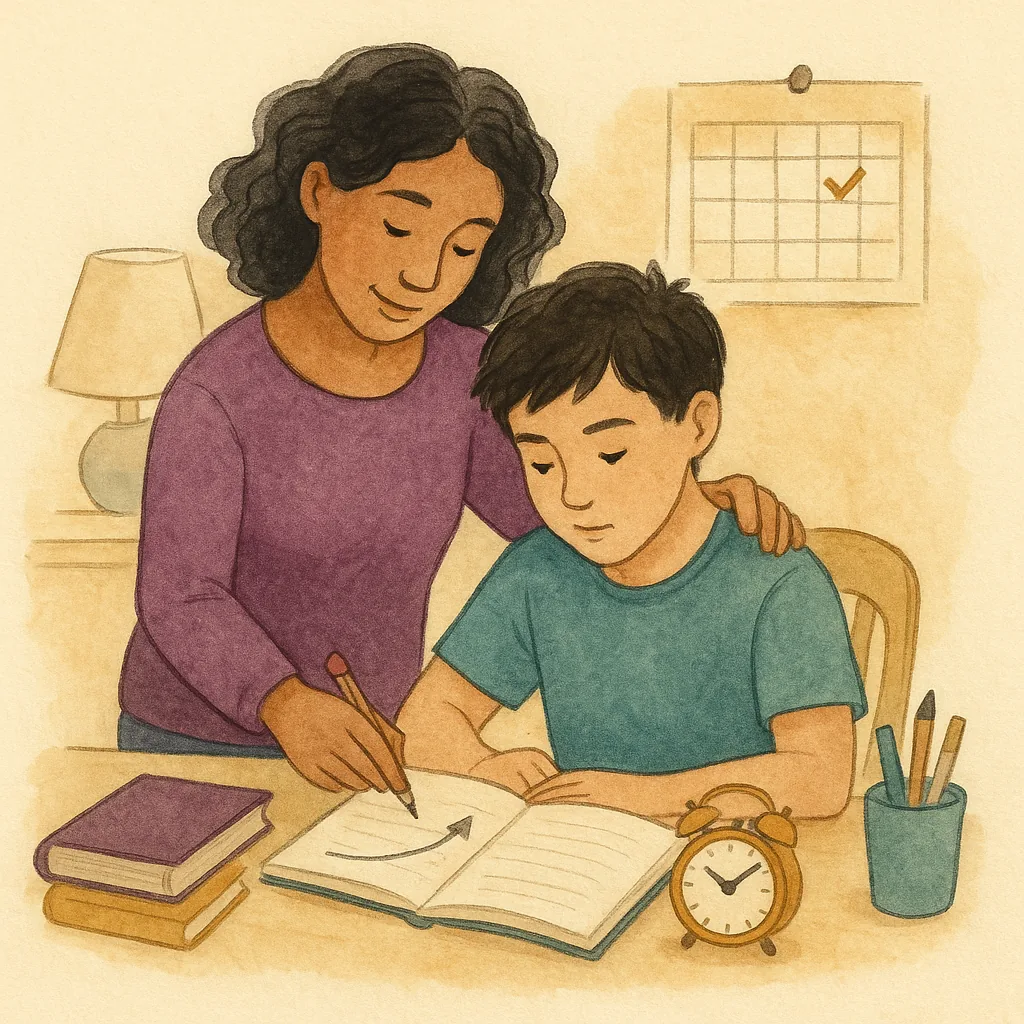
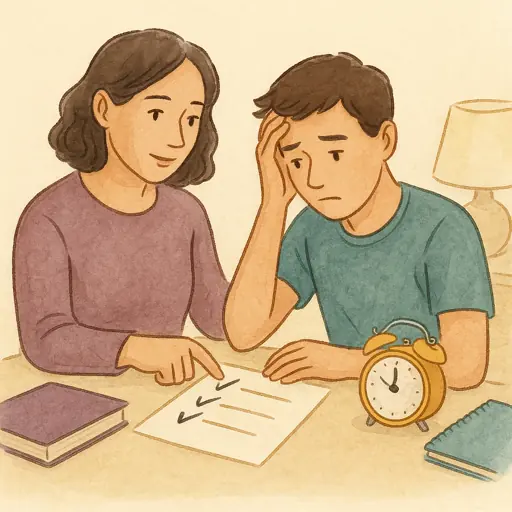
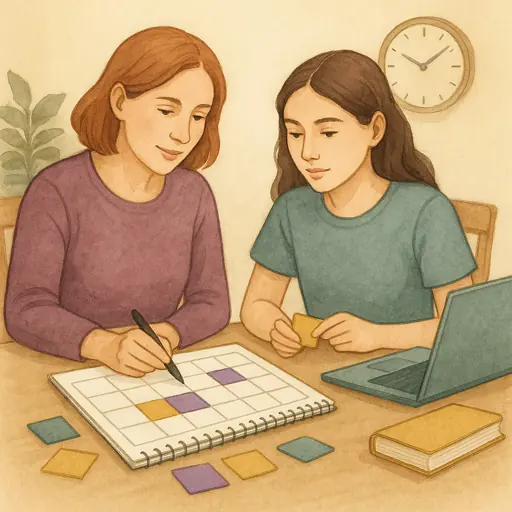
Exam season can turn a family home into a badly managed operations center. Notes spread across every surface. Everyone asks whether enough studying has happened. The child alternates between confidence, panic, and an urgent need to reorganize a drawer.
Parents are most useful when they manage conditions, help the child make decisions, and protect recovery—not when they become a second examiner.
The aim is not to remove all stress. It is to keep stress informative rather than chaotic.
Define the exam landscape
Create one page containing:
- exam dates and times;
- subjects;
- format and duration;
- topics or specifications;
- allowed materials;
- current readiness;
- target or required outcome;
- major deadlines occurring at the same time;
- accommodations and logistics;
- school guidance on preparation.
Then label each subject:
- Secure: mostly accurate under realistic conditions;
- Developing: understands but performance is inconsistent;
- Priority: important gaps or high stakes;
- Clarify: format, content, or expectations are unknown.
This prevents equal time from being spent on unequal needs.
Use diagnostics before building the plan
Do not begin by rereading every chapter from the beginning.
Use a short, representative sample:
- mixed practice questions;
- a timed section;
- a blank-page recall;
- an essay plan;
- a past paper excerpt;
- an oral explanation;
- a teacher-provided review task.
Record more than the score. Classify errors:
- missing knowledge;
- misunderstood concept;
- wrong strategy;
- weak recall;
- timing;
- question misread;
- incomplete evidence;
- arithmetic or transcription;
- checking failure;
- anxiety or blanking.
Two students with 60 percent need different plans if one lacks content and the other runs out of time.
Set priorities by value, not emotion
Students often study what feels comfortable or what frightens them most. Neither is automatically the best allocation.
Prioritize using:
- importance or weighting;
- size of the gap;
- likelihood that practice will improve it;
- dependency on prerequisite knowledge;
- time available;
- the child’s energy and course load.
A useful question is:
“Which ninety minutes of work would most change readiness?”
That might be repairing one algebra foundation, practicing two essay structures, or learning to interpret command words—not color-coding every note.
Use a learning cycle, not endless review
A strong exam-prep cycle contains:
1. Clarify
Learn or reteach the concept.
2. Retrieve
Close materials and produce the knowledge.
3. Apply
Use it in varied or exam-style questions.
4. Check
Compare with answers, rubric, or model.
5. Analyze
Identify why errors occurred.
6. Revisit
Return after a delay.
Rereading and highlighting can support initial orientation. They are weak as the entire plan because they do not test whether information can be produced when the page is absent.
Space and mix the work
Instead of one enormous subject session, return across days.
Example:
- Monday: learn and retrieve a topic;
- Wednesday: mixed questions;
- Friday: timed application;
- Sunday: error-based review.
Mixing related problem types teaches the student to choose methods rather than follow the visible pattern of a worksheet section.
Do not mix material before basic understanding exists. Confusion is not automatically productive because it arrived in a varied order.
Create a weekly exam meeting
Keep it short and factual.
Ask:
- What changed since last week?
- Which evidence shows readiness?
- Which error pattern repeats?
- What is the highest-value task next?
- Is the schedule still realistic?
- What support is needed from the parent?
- What can be removed?
The meeting should end with decisions, not a speech about future consequences.
Protect sleep as part of preparation
Sleep supports attention, memory, emotional regulation, and learning. Late-night cramming often trades tomorrow’s performance for the feeling of doing something tonight.
Help the child:
- keep a stable sleep window;
- stop demanding work before bed;
- prepare materials earlier;
- reduce late caffeine;
- move unfinished low-value tasks rather than automatically borrowing from sleep;
- use the final evening for targeted recall and logistics, not first exposure to major topics.
If the study plan repeatedly requires sleep sacrifice, the plan is overloaded or started too late. Moral intensity does not create extra hours.
Practice under realistic conditions—but not constantly
Students need some experience with:
- time limits;
- section order;
- permitted tools;
- answer format;
- screen or paper interface;
- breaks;
- moving on from difficult items;
- checking within the time available.
Full simulations are useful diagnostics. They are also tiring and expensive in time. Use them periodically, then spend more time learning from the results.
A practice test without error analysis is an elaborate way to obtain a number the student already suspected.
Build an error log that changes behavior
Use:
| Question type | Error | Cause | New rule | Follow-up |
|---|---|---|---|---|
| Linear equation | Lost negative sign | Simplified too quickly | Circle signs before combining | 5 mixed items Wed |
| Reading inference | Chose plausible but unsupported answer | Did not locate evidence | Require two text clues | Timed set Fri |
| Essay | Weak conclusion | Ran out of time | Reserve final 5 minutes, use 2-sentence structure | Practice Sun |
Review the log before the next practice. Otherwise it becomes a beautifully organized record of errors that continue unchanged.
Teach a pacing strategy
For timed exams, the child should know:
- average time per section or question;
- checkpoint times;
- which questions to skip and return to;
- how guesses are handled under the rules;
- when to stop overinvesting in one item;
- how much time to reserve for checking;
- whether answers can be changed within the interface.
Practice the strategy. Do not introduce it in the car on test morning.
Help without becoming the proctor
Useful parent roles:
- protect study time;
- help build the calendar;
- provide meals and transport;
- quiz on request;
- print or organize materials;
- ask for evidence of readiness;
- help reduce competing demands;
- support communication with teachers;
- notice distress or health concerns.
Unhelpful roles:
- repeatedly asking “Are you studying?”;
- checking every answer;
- comparing siblings;
- announcing financial or life consequences;
- adding extra practice without diagnosis;
- treating breaks as laziness;
- turning every meal into score analysis;
- making parental anxiety the child’s management task.
Use language that reduces threat without denying stakes
Avoid:
- “This exam determines your future.”
- “You have nothing to worry about.”
- “Do not disappoint us.”
- “You should have started earlier” during the final week.
- “Just be confident.”
Try:
- “This matters, and it is still one piece of information about your learning.”
- “What is controllable today?”
- “Which practice result should guide the next session?”
- “You do not need to feel calm to follow your plan.”
- “We will discuss the result after you have recovered, not predict your worth before it happens.”
Taper before the exam
In the final one or two days:
- review high-value cues and error patterns;
- complete a short confidence-building set;
- avoid exhausting full simulations unless specifically planned;
- verify logistics;
- prepare permitted materials;
- protect sleep;
- stop at a defined time.
Last-minute learning can help when a key gap remains, but frantic exposure to everything usually increases noise.
Support multiple exams as a portfolio
When several exams cluster, do not optimize each independently. Allocate across the whole system.
Consider:
- which exam comes first;
- where readiness is lowest;
- which content benefits from spaced review;
- which task can be maintained with brief retrieval;
- which subject has a hard prerequisite;
- where a small improvement matters most;
- where overstudying produces little return.
The best plan may intentionally accept “good enough” in one subject to prevent collapse across three others.
Accommodations and access
Confirm approved accommodations early:
- extended time;
- breaks;
- testing setting;
- assistive technology;
- screen-reader or large-print support;
- medication or medical arrangements;
- language-related provisions where applicable.
Practice using the same supports. An accommodation is not an advantage if the student first encounters it on exam day.
If expected support is missing, contact the school before the test rather than asking the child to negotiate under pressure.
When stress needs professional attention
Seek school or clinical support when anxiety causes:
- panic attacks;
- persistent sleep disruption;
- vomiting or significant physical symptoms;
- refusal to attend;
- self-harm thoughts or statements;
- severe impairment beyond exam situations;
- substance use;
- inability to function despite preparation;
- prolonged depression or hopelessness.
Study techniques cannot substitute for mental-health care.
The parent exam-season checklist
- Dates and formats confirmed
- Current readiness sampled
- Errors classified
- Priorities chosen
- Study tasks are concrete
- Retrieval and spacing included
- Full practice used selectively
- Sleep protected
- Logistics prepared
- Accommodations confirmed
- Parent support agreed
- Final taper planned
- Post-exam recovery protected
Sophia’s rule: Parents should reduce operational chaos, make preparation evidence-based, and leave the child responsible for the learning.
Use Sophia to focus the next session
Upload the syllabus, review guide, or a sample of missed questions. Ask Sophia to classify gaps, generate targeted retrieval and application questions, and explain one misconception at a time. Keep regular closed-tool practice so readiness reflects what the child can produce independently.
Exam season becomes more manageable when the family stops asking, “Have you done enough?” and starts asking, “What does the evidence say should happen next?”