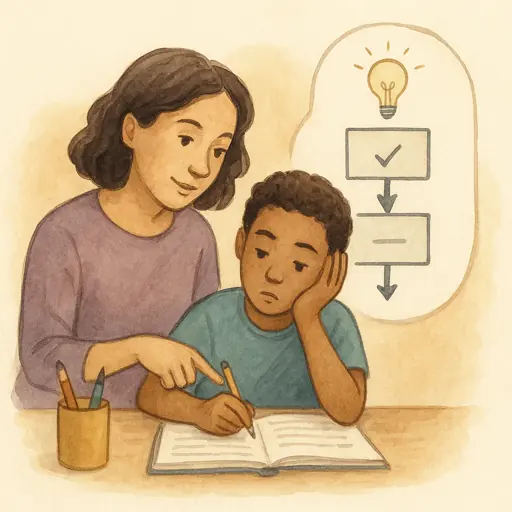
How to Help With Homework Without Giving Away the Answer
Diagnose why a child is stuck, give the smallest useful hint, and check real understanding without completing the homework for them.

Your child asks for help. You look at the worksheet, remember approximately twelve percent of seventh-grade math, and immediately face three bad options:
- give the answer;
- deliver a surprise forty-minute lecture;
- announce that the Wi-Fi appears to have died under mysterious circumstances.
There is a better role for a parent: not answer key, not substitute teacher, but temporary guide. The goal is to help your child restart their own thinking, then step back as soon as they can continue.
That distinction matters. A child can finish an assignment with a great deal of adult help and learn almost nothing from it. Conversely, a small, well-timed prompt can preserve both the learning and the child’s sense that they were the one who solved the problem.
First, decide what “help” is supposed to accomplish
Parents often optimize for the most visible outcome: a completed worksheet before bedtime. The more important outcome is less visible: can the child do a similar task tomorrow without you?
Those two goals sometimes conflict. Supplying the next step makes tonight faster. Asking the child to retrieve a rule, draw a model, or explain the question may feel slower, but it builds a route they can reuse.
A useful parent rule is:
Help should reduce confusion, not remove thinking.
Diagnose the blockage before explaining anything
“What don’t you understand?” is usually too broad. A child who is already confused cannot always diagnose their own confusion. Instead, identify which kind of blockage you are dealing with.
1. The language is unclear
The child does not understand a word, symbol, direction, or sentence.
Try:
- “Which word changes what you are supposed to do?”
- “Can you say the question in ordinary language?”
- “What does a finished answer need to include?”
2. The relevant knowledge is missing
The child understands the task but cannot recall a fact, definition, formula, spelling pattern, or earlier concept.
Try:
- “Where in your notes did you use this idea before?”
- “What smaller fact would help here?”
- “Can you show me an example from class?”
3. The child knows the pieces but cannot choose a strategy
They can explain the topic but do not know how to begin.
Try:
- “What have you tried?”
- “Does this resemble a problem you solved earlier?”
- “Could you draw it, make a table, or use a simpler example?”
4. The strategy is right, but execution broke down
The child selected a reasonable method but made an arithmetic, copying, grammar, or sequencing error.
Try:
- “Read each line and tell me what changed.”
- “Check the units, signs, or copied numbers.”
- “Where does your result first stop matching your plan?”
5. The child cannot judge whether the answer makes sense
They have an answer but no checking method.
Try:
- “What would a reasonable answer be roughly?”
- “Can you check this in a different way?”
- “What would happen if one number became much larger?”
6. The real problem is overload, fatigue, or emotion
Sometimes the worksheet is not the main obstacle. A hungry, exhausted, ashamed, or already-frustrated child has less working memory available for the task.
Try:
- “Do you need help with the problem, or do you need five minutes before the problem?”
- “Let’s choose the smallest part to finish first.”
- “We can pause without declaring the entire evening a national emergency.”
Use the least-help ladder
Once you know where the blockage is, begin with the smallest intervention. Move up only when the current level is not enough.
Step 1: Ask the child to show their current thinking
Do not begin by teaching. Ask them to point to the exact place where their reasoning stopped.
Useful prompts:
- “Talk me through what you did.”
- “What were you expecting to happen next?”
- “Which part are you confident about?”
This does two jobs. It gives you diagnostic information, and it often helps the child notice their own mistake.
Step 2: Clarify the goal
Explain what the task is asking without suggesting a solution method.
For example:
“You are not being asked to calculate every price. You are being asked to compare the price per item.”
That may be enough for the child to restart.
Step 3: Point toward a useful representation or resource
Suggest a tool, not an answer:
- draw a number line;
- make a two-column table;
- reread one paragraph;
- find the worked example;
- label the units;
- replace difficult numbers with easy ones;
- say the idea aloud before writing it.
Then stop talking. Adults often stack hints because silence feels awkward. But the pause is not dead air. It is where the child converts help into thought.
Step 4: Give one directional hint
A directional hint narrows the field but leaves a meaningful choice to the learner.
Weak hint:
“Divide by three.”
Stronger hint:
“You know the total for three equal groups. What would help you find one group?”
The second prompt identifies the relationship without performing the decision for the child.
Step 5: Teach the missing idea
When the child genuinely lacks the concept, pretending they can “discover” it through increasingly cryptic questions becomes its own form of torture. Explain the idea directly, but keep the child active.
A strong mini-lesson has four parts:
- explain the concept in plain language;
- model one example while naming the reason for each step;
- solve a second example together;
- hand a similar example back to the child.
Support should fade as understanding grows. Do not end with the parent’s polished performance and assume learning happened by osmosis.
Use a transfer check, not “Do you understand?”
Children often say “yes” because the explanation sounded clear, because they want to move on, or because bedtime is approaching like an incoming asteroid.
Instead, ask for evidence of understanding:
- “Explain why that step works.”
- “Solve this similar problem without looking at ours.”
- “What would change if the numbers were different?”
- “Show me the mistake someone might make here.”
- “Teach the idea back to me in thirty seconds.”
A correct answer to the original problem may reflect memory of your explanation. A similar problem reveals whether the child can transfer the idea.
A practical example
Imagine the problem says:
A recipe uses three cups of flour for two loaves. How much flour is needed for five loaves?
Your child says, “I don’t get it.”
A parent could immediately set up a proportion. That would finish the item, but it would hide the child’s actual difficulty.
Instead:
Diagnose: “What quantities are changing?”
Clarify: “We know flour for two loaves and need flour for five loaves.”
Represent: “Could you make a table with loaves in one column and cups in the other?”
Hint: “What amount of flour would one loaf use?”
Transfer check: “If four cups made three loaves, how would your method change?”
The child still performs the important reasoning. You supplied a path, not a finished journey.
What not to do
Do not turn questions into disguised commands
“Don’t you think you should subtract?” is an answer wearing a tiny question-mark costume.
Do not correct every mistake at once
If the child has the main concept but made one arithmetic error, do not restart the entire lesson from the invention of numbers.
Do not praise speed as the main sign of ability
Fast completion can mean fluency, but it can also mean guessing, copying, or avoiding difficult thought. Praise useful behaviors instead:
- noticing an error;
- changing strategy;
- checking units;
- asking a precise question;
- persisting after a reasonable pause.
Do not let help become surveillance
Hovering over every line can turn support into pressure. Agree on checkpoints: “Try the first two problems, then call me if the same issue appears.”
Do not keep going after the relationship has collapsed
If voices rise, the child shuts down, or every prompt is heard as criticism, learning has probably stopped. Take a break, reduce the task, or write a question for the teacher.
When the child needs more than homework help
One difficult assignment is normal. A repeated pattern deserves attention.
Contact the teacher or consider additional support when:
- the same foundational gap appears across several assignments;
- homework takes dramatically longer than expected;
- the child can follow an example but cannot begin independently;
- reading the instructions is consistently harder than the academic content;
- anxiety, tears, stomachaches, or avoidance happen regularly;
- the parent-child relationship is becoming the cost of completing schoolwork;
- the child may need an evaluation, accommodation, or targeted intervention.
Bring specific evidence, not only “homework is hard.” For example:
“She can calculate fractions once the equation is written, but she cannot translate word problems into equations without step-by-step help.”
That gives a teacher far more to work with.
The five-minute parent protocol
When you need something simple enough to remember at 8:47 p.m., use this sequence:
- Show me: “Tell me what you have tried.”
- Name it: Identify whether the blockage is language, knowledge, strategy, execution, checking, or overload.
- Nudge once: Give the smallest useful prompt.
- Wait: Let the child act on it.
- Hand it back: Ask for an explanation or similar problem.
Sophia’s rule: Give the smallest amount of help that lets the learner take the next meaningful step.
Use Sophia without turning it into an answer machine
Upload the full assignment and begin with Level 1: Understand the assignment. Let Sophia clarify what the task expects without revealing the method or answer. Open a deeper hint only when the child has made a real attempt and can explain where they are stuck.
The goal is not merely to finish tonight’s page. It is to make tomorrow’s page require a little less help.