The Three-Level Hint Method Every Parent Can Use
Use a three-level hint system to clarify homework, give a productive nudge, and teach when needed while preserving independent thinking.
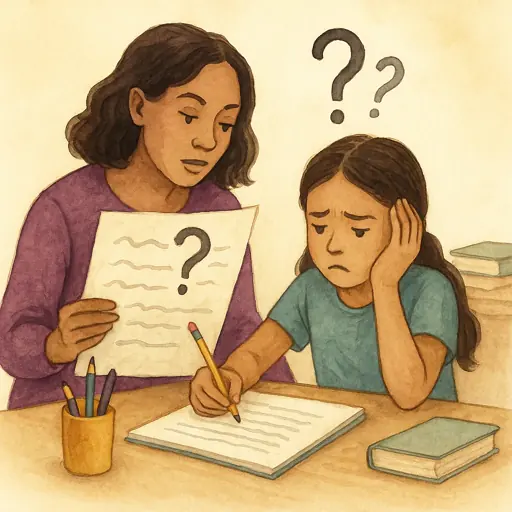
Most homework help fails in one of two directions. A parent says, “Think harder,” which is not a strategy. Or the parent explains every step, and the child becomes a highly efficient spectator.
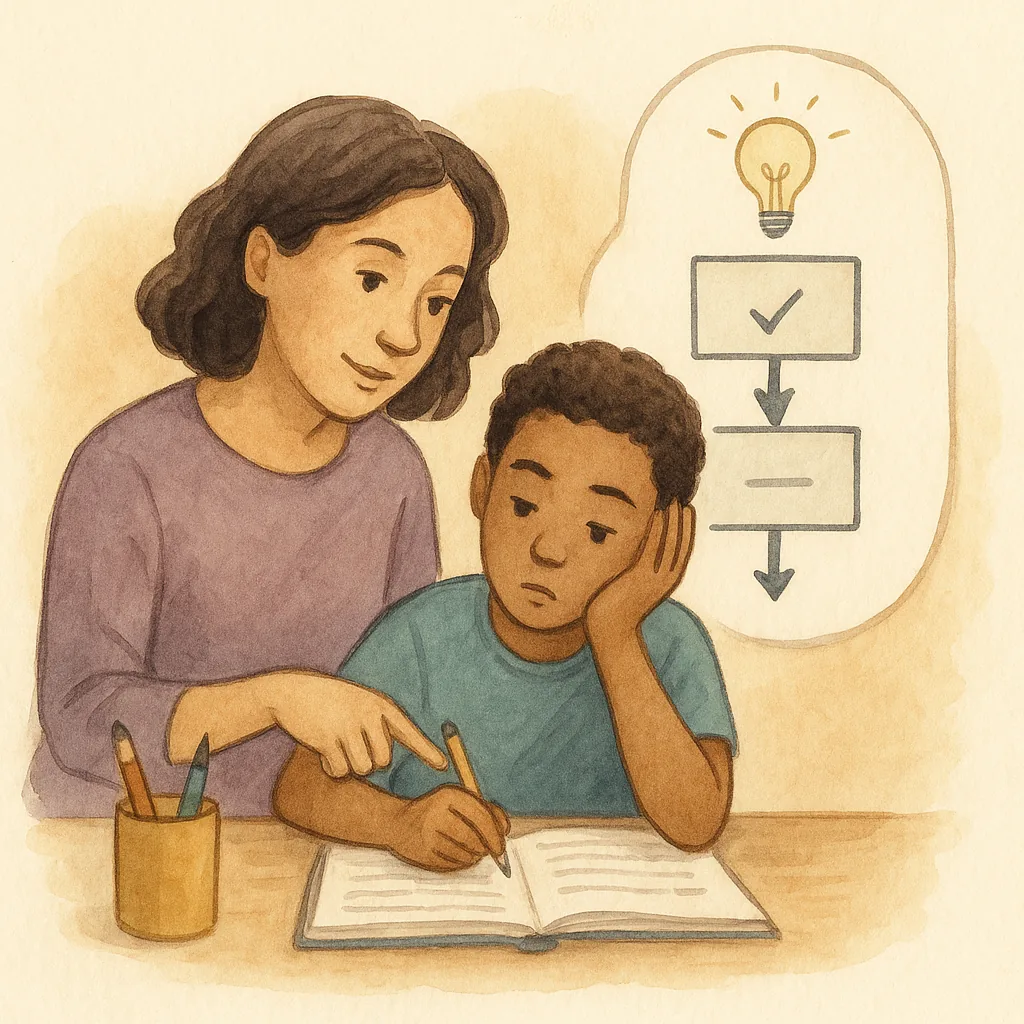
The three-level hint method creates a useful middle. It helps you calibrate support instead of improvising a new family education policy over every worksheet.
The levels are:
- Clarify the task — explain what the child is being asked to do.
- Point in a direction — reveal a useful relationship, tool, or next question.
- Teach the solution — explain the full reasoning, then return responsibility to the child.
The method is simple. Using it well requires one discipline: never give more help merely because you know more help.
Before Level 1: require an observable attempt
An “attempt” does not have to be correct or lengthy. It might be:
- underlining the question;
- naming the known information;
- writing one possible first step;
- explaining why two answer choices seem plausible;
- drawing a rough model;
- identifying the sentence that became confusing.
This prevents a habit in which “I don’t know” becomes a button that summons a complete solution.
Use a neutral prompt:
“Show me what you can tell from the problem before we choose a help level.”
There are exceptions. If the child does not understand the vocabulary, has never been taught the concept, or is already overwhelmed, insisting on a ceremonial failed attempt adds frustration without learning. The point is to make thinking visible, not to demand suffering as an entrance fee.
Level 1: clarify the task without suggesting a method
At Level 1, your child should finish with a clearer picture of the destination but still choose the route.
Ask:
- What is the task asking you to produce?
- What information are you given?
- Which words define the type of answer?
- What constraints must the answer follow?
- How will you know the response is complete?
Math example
Problem: “A store discounts a $60 jacket by 25 percent. What is the sale price?”
Level 1:
“The question is asking for the price after the discount, not only the amount of the discount.”
You have clarified the output without naming an operation.
Reading example
Question: “Which detail best supports the author’s main claim?”
Level 1:
“You need two things: identify the author’s main claim, then choose the detail that provides the strongest evidence for it.”
Writing example
Assignment: “Evaluate whether the character’s decision was justified.”
Level 1:
“You need to make a judgment and support it with reasons or evidence. A plot summary alone will not answer the task.”
Science example
Question: “Explain why the temperature changed.”
Level 1:
“The answer needs a cause-and-effect explanation, not only a description of the temperature before and after.”
The stop rule for Level 1
After clarifying, ask:
“Do you now have a first step?”
If the child starts working, stop helping. Do not upgrade to Level 2 because you had already prepared a magnificent speech.
Level 2: provide direction while leaving a decision
At Level 2, give one clue that narrows the problem but does not complete the reasoning.
Useful types of Level 2 hints include:
Point to a relationship
“Which two quantities are being compared?”
Suggest a representation
“Try putting the information into a table.”
Activate prior knowledge
“This has the same structure as the example where you found a unit rate.”
Reduce complexity
“What would you do if the numbers were 10 and 2?”
Direct attention
“Reread the sentence beginning with ‘however.’ What changes there?”
Offer a choice of strategies
“Would a diagram or an equation make the relationship easier to see?”
A good Level 2 hint leaves at least one meaningful cognitive action to the learner: choosing, connecting, representing, calculating, explaining, or checking.
One hint, then wait
Parents frequently deliver a useful hint and then, before the child can process it, add two more hints, a worked example, and a brief memoir about how school was tougher in 1998.
Give one hint. Wait long enough for the child to use it. If the hint fails, ask what it changed in their understanding before adding another.
“What does that hint help you notice?”
This keeps hints from becoming disconnected instructions.
Level 3: teach the full solution without creating dependence
Level 3 is not failure. Sometimes the child lacks prerequisite knowledge, the teacher’s example did not land, or the assignment expects a method they have not mastered. In those cases, direct explanation is more honest than twenty leading questions.
A strong Level 3 walkthrough contains five parts.
1. State the big idea
“A percent discount tells us what fraction of the original price is removed.”
2. Explain the first decision
“We first find the discount amount because the final price is the original price minus that amount.”
3. Name the reason for every step
Do not say only what to do. Explain why the move preserves meaning.
4. Check the result
“A 25 percent discount should make the price smaller by one quarter. Does our answer fit that expectation?”
5. Hand the next example back
Immediately use a similar problem with changed numbers or context.
“Now try a $40 item discounted by 15 percent. Tell me the plan before you calculate.”
Without this final hand-back, the walkthrough measures whether the child can follow an explanation, not whether they can use it.
Move both up and down the ladder
The levels are not a one-way escalator toward more help.
A typical sequence may look like this:
- Level 1 clarification;
- Level 2 hint;
- child completes two steps;
- Level 3 explanation of one missing concept;
- return to Level 1 on a similar problem;
- child solves independently.
The long-term goal is fading: less support as competence grows. If the child needs the same Level 3 explanation every night, the issue is no longer hint selection. There is likely a foundational gap that needs deliberate instruction.
How to tell whether a hint was too large or too small
Too small
- The child cannot explain what the hint refers to.
- It adds another vague instruction: “Just think logically.”
- It assumes knowledge the child does not have.
- The child remains frozen after a reasonable pause.
Too large
- The hint contains the operation, answer, thesis, or interpretation.
- The child can follow it only by copying.
- No meaningful choice remains.
- The child finishes but cannot explain why the method works.
About right
- The child’s next action becomes visible.
- Some thinking still remains.
- The child can explain how the hint changed their plan.
- A similar task requires less help.
Adapt the levels by age
Younger children
Use concrete language and physical representations. Keep prompts short.
- Level 1: “Show me what you need to find.”
- Level 2: “Can the blocks help us show it?”
- Level 3: model one example, then let the child build the next.
Middle-school students
Ask them to name the task type, choose representations, and explain errors. Avoid taking the pencil unless you are modeling one short step.
Teenagers
Respect autonomy. Agree on the level of help before beginning:
“Do you want me to clarify the question, give one nudge, or teach the whole concept?”
The teenager may misjudge what they need. That is fine. Choosing a level is itself practice in monitoring their learning.
Common failures of the method
The disguised-answer hint
“What do you get when you divide 60 by 3?”
If choosing division was the hard part, this prompt has already solved it.
Hint stacking
Three hints delivered in one breath are effectively a walkthrough with missing punctuation.
Endless Socratic interrogation
Questions are useful only when the child has enough knowledge to reason from them. When they do not, teach.
No transfer check
Finishing the original problem is not evidence that the skill can be used elsewhere.
Help that expands automatically
A child says “I don’t know,” and the parent jumps straight to Level 3. Ask for the exact point of uncertainty first.
The refrigerator-card version
You can remember the entire method with three questions:
Level 1 — What is this asking?
Clarify the goal, information, and required output.
Level 2 — What could help you begin?
Point to a relationship, representation, example, or resource.
Level 3 — Why does the method work?
Teach the reasoning, model it, check it, and hand back a similar task.
After every level, use the same final question:
“Can you take the next step without me?”
Sophia’s rule: Support should expand only when the learner needs it—and shrink as soon as they do not.
Use the levels deliberately with Sophia
Every Sophia explanation can be opened progressively. Start with a no-answer clarification. Let the child make an attempt. Reveal one directional hint only if they remain stuck. Use the full solution as instruction, then close it and ask the child to solve or explain a similar problem independently.
The smartest help is not the most detailed help. It is the amount that produces the next piece of independent thinking.