What to Do When the Assignment Instructions Make No Sense
Decode vague assignment instructions, find missing context, use rubrics, and help a child ask teachers precise, answerable questions.
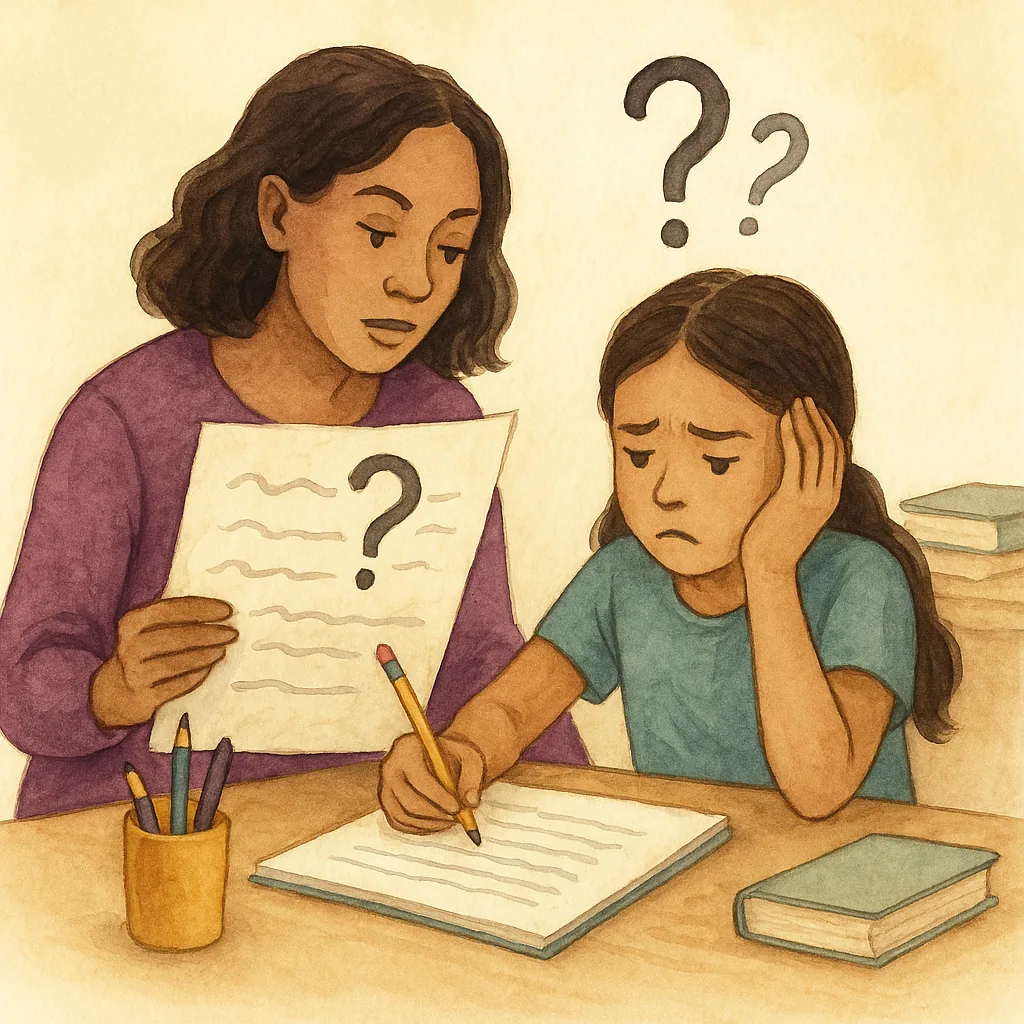
Sometimes the hardest part of homework is not algebra, biology, or writing. It is the sentence at the top of the page that appears to have been produced by a committee of exhausted robots:
“Analyze the relevant features and respond appropriately using evidence from the material.”
Appropriately how? Which features? How much evidence? In what format? By Tuesday, apparently, because ambiguity enjoys a deadline.
When directions are unclear, do not begin by guessing at the academic answer. First reconstruct the assignment itself.
Treat instructions as a specification
Most assignments contain six ingredients, even when they are scattered across a worksheet, classroom portal, rubric, and teacher announcement.
- Action: What kind of thinking must the student do?
- Content: What topic, text, problem, or source should they use?
- Product: What must they submit?
- Evidence: What must support the answer?
- Constraints: Length, format, tools, collaboration rules, or required method.
- Deadline and submission: When, where, and how it must be turned in.
Create a quick assignment map:
| Element | What we know | What is missing |
|---|---|---|
| Action | Compare | Criteria for comparison |
| Content | Two characters | Whole novel or one chapter? |
| Product | Written response | Paragraph or essay? |
| Evidence | Text evidence | Number of quotations unclear |
| Constraints | Typed | Length unclear |
| Submission | Friday online | File format unclear |
The table turns a vague feeling—“none of this makes sense”—into two or three precise uncertainties.
Find the command verb
The main verb usually reveals what kind of thinking the teacher expects.
Identify
Name or select the relevant item. A brief answer may be enough.
Describe
State what something is like, what happened, or what features it has.
Explain
Show how or why. A bare fact is usually insufficient.
Compare
Discuss meaningful similarities, differences, or both. Listing two separate summaries is not necessarily comparison.
Analyze
Break something into parts and explain relationships, patterns, causes, choices, or effects.
Evaluate
Make a judgment using stated criteria and evidence.
Justify
Defend a conclusion, method, or choice with reasons or evidence.
Summarize
Give the central ideas in a shorter form without reproducing every detail.
Discuss
This famously flexible verb usually requires explanation and support, but the expected depth depends on the class. Look for a rubric, model, or previous example.
Ask your child:
“What would someone have to see in the finished work to know you really did that verb?”
That question translates an abstract command into observable features.
Separate the layers of the assignment
A page may contain:
- directions that apply to every question;
- background information;
- an example;
- the actual prompt;
- formatting rules;
- a rubric;
- optional extension work.
Children commonly answer the example, miss a direction in the header, or treat a formatting rule as part of the academic question.
Rewrite the task as a sequence of actions:
“First read the passage. Then choose one claim. Next find two details that support it. Finally explain how each detail supports the claim in one paragraph.”
A dense block of prose consumes working memory. A short sequence makes the task executable.
Search for hidden context before inventing an interpretation
Unclear directions often depend on information outside the cropped photo or current screen.
Check for:
- the previous page;
- an attachment;
- an example completed in class;
- notes or a textbook section;
- a rubric;
- a class announcement;
- a linked template;
- a definition introduced earlier;
- teacher comments on similar work;
- oral instructions the child may remember only partially.
Ask the child to reconstruct the classroom context:
- “Did the teacher show a model?”
- “Was this connected to yesterday’s lesson?”
- “Did the class choose topics already?”
- “Does the rubric mention what the prompt leaves out?”
Do not assume missing context means the child was inattentive. Oral directions disappear quickly, learning platforms hide attachments creatively, and adults also fail to remember every detail from meetings.
Read the rubric before doing the work
A rubric often provides a clearer definition of the assignment than the prompt itself.
Turn each criterion into a checkable requirement:
Rubric language:
“Uses relevant and sufficient evidence.”
Checklist translation:
- At least two pieces of evidence directly support the claim.
- Each piece is explained, not merely inserted.
- Evidence comes from the assigned material.
Rubric language:
“Demonstrates logical organization.”
Checklist translation:
- The main claim appears early.
- Each paragraph has one purpose.
- Ideas follow a deliberate order.
- Transitions show how sections connect.
The goal is not to reverse-engineer points like tiny academic accountants. It is to make quality visible before the child starts.
Distinguish ambiguity from unfamiliarity
Sometimes the direction is clear, but the child does not know the academic convention behind it.
For example:
- “Show your work” may mean equations and key steps, not every thought.
- “Use evidence” may require quotation plus explanation.
- “Write in complete sentences” changes the expected form, not only grammar.
- “Create a model” may mean a diagram representing a system, not a decorative poster.
- “Cite your sources” requires a specific citation style the child may not know.
Ask:
“Is the wording unclear, or is the expected school format unfamiliar?”
Those require different help. Wording can be paraphrased. An unfamiliar convention needs an example or direct instruction.
Ask the teacher a question that can actually be answered
“I don’t understand the assignment” forces the teacher to guess which of twelve things is unclear.
Teach your child to send a precise question:
“The prompt says to compare the two characters. Should the comparison use evidence from chapter four only or from the whole novel?”
Or:
“The rubric mentions three sources, but the assignment page says two. Which requirement should we follow?”
A useful message contains:
- what the student thinks the task means;
- the exact ambiguity;
- the specific decision they need clarified;
- enough lead time for a response.
This is not helplessness. It is professional communication, a skill your child will later use with professors, managers, clients, and every person who writes “just a quick thing” without describing the thing.
When the teacher is unavailable: make a defensible interpretation
Sometimes the deadline arrives before clarification. Do not pretend certainty. Choose the interpretation best supported by the available evidence and make the assumption visible when appropriate.
Use this hierarchy:
- explicit written directions;
- rubric requirements;
- teacher-provided example;
- recent class practice;
- standard convention for the subject;
- a reasonable minimal interpretation.
The child might add a brief note:
“I interpreted ‘two examples’ as two examples total rather than two per paragraph.”
This does not guarantee the teacher will accept the choice, but it demonstrates careful reasoning rather than random guessing.
A worked example
Assignment:
“Create a representation of an ecosystem and explain its interactions.”
The child wants to draw a forest and label five animals.
Step 1: identify the action
“Create” and “explain.” The task needs both a representation and an explanation.
Step 2: identify the content
An ecosystem and its interactions—not merely a collection of organisms.
Step 3: define the product
Probably a diagram plus written or oral explanation. Check the rubric.
Step 4: identify evidence of completion
The model should show relationships such as energy flow, predation, competition, decomposition, or environmental effects.
Step 5: find uncertainty
Does the teacher require a particular ecosystem, number of organisms, or format?
Step 6: create a checklist
- The ecosystem is named.
- Producers, consumers, and decomposers are included.
- Arrows have a defined meaning.
- At least three interactions are explained.
- Nonliving factors are represented.
- The required format and deadline are followed.
The child now knows what to build without a parent designing the project for them.
Watch for a repeated pattern
If your child frequently cannot interpret ordinary classroom directions, look beyond the individual assignment. Possible contributors include:
- weak academic vocabulary;
- reading-comprehension difficulties;
- attention or working-memory challenges;
- language-learning needs;
- anxiety that makes starting harder;
- inconsistent teacher instructions;
- missing accommodations;
- executive-function difficulties with multi-step tasks.
Keep examples and discuss the pattern with the teacher. “He missed four assignments” is less diagnostic than:
“He understands the subject once the task is broken into steps, but he consistently misses requirements embedded in multi-part written directions.”
The assignment-decoding checklist
Before your child starts, ask:
- What is the command verb?
- What exact product must be submitted?
- What source material should be used?
- What counts as evidence?
- What constraints apply?
- Is there a model or rubric?
- What information is missing?
- What precise question should we ask?
- If no answer arrives, what interpretation is most defensible?
- How will we check completion before submission?
Sophia’s rule: Clarify what must be produced before explaining how to produce it.
Use Sophia to clarify, not guess
Upload the complete assignment—including headings, examples, rubric, diagrams, and surrounding instructions. Start with Level 1 so Sophia separates the task from the content and describes what the student is expected to produce without solving it.
If something genuinely appears missing, treat that as a finding, not an invitation to manufacture teacher intent. Good help makes uncertainty precise.